I recently bought the Fantagraphics complete Mauldin's Willie and Joe in soft cover. Bill Mauldin is one of the indisputable geniuses in the history of cartooning and I consider it an obligation to have the best available collection of his work on my shelf. From the photo you can see that this has meant periodic updating.

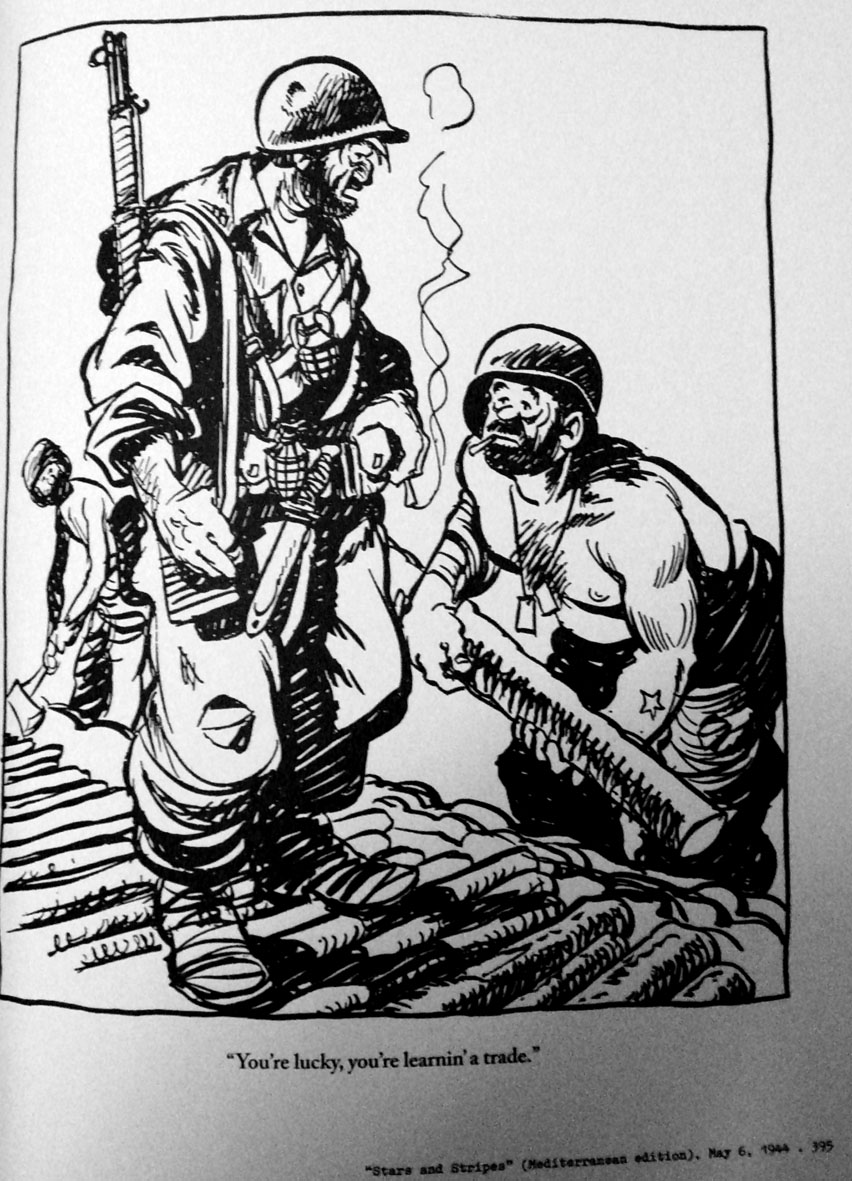
The attraction of the Fantagraphics collection is that it is the first to date everything and put it all in chronological order. (In the intro to one of the earlier collections Mauldin confessed some regret at having removed the dates in an earlier edition for the sake of grouping the cartoons thematically, and allowed that putting them back on would now require a great deal of research). I expected this to bring about one or two observations that I could not have made before. The first is that I am surprised to find that there is no break between the war cartoons and the post-war cartoons. They are continuous. the second is that in the middle of 1944 Mauldin appears to have decided to stretch the proportions of his figures from a normal height of seven or eight 'heads' to as many as ten heads (previously I presumed variotions might be explained by pressing circumstances). These are two from before this apparent decision:
3-25-44

5-6-44

And these are two from after it:
9-11-44

4-11-45

This reminded me of the big pictorial book on World War 2 (1975) by James Jones (of From Here to Eternity). I haven't seen it in years, but I recall that there was a section on War Artists, in which he discussed the art of a particular artist who intentionally used stretched 'heroic' proportions in his figures. I realize that most of this kind of thing will not look strange to the modern reader accustomed to looking at comic books, in which Rob Liefeld once notoriously stretched a figure to as many as fourteen heads (I think Gibbons used the heroic ten heads in Watchmen). Anyway, I forget the name of the artist Jones was talking about, but the strongest candidate is Howard Brodie:


So I'm wondering if Mauldin came into contact with Brodie and or his work in the middle of 1944. Or maybe there's another explanation.
Update. PS- You can see how the heroic proportion brings a gravitas to the drawing that won Maudin the Pulitzer.
10-13-44

earlier post on Mauldin.

The attraction of the Fantagraphics collection is that it is the first to date everything and put it all in chronological order. (In the intro to one of the earlier collections Mauldin confessed some regret at having removed the dates in an earlier edition for the sake of grouping the cartoons thematically, and allowed that putting them back on would now require a great deal of research). I expected this to bring about one or two observations that I could not have made before. The first is that I am surprised to find that there is no break between the war cartoons and the post-war cartoons. They are continuous. the second is that in the middle of 1944 Mauldin appears to have decided to stretch the proportions of his figures from a normal height of seven or eight 'heads' to as many as ten heads (previously I presumed variotions might be explained by pressing circumstances). These are two from before this apparent decision:
3-25-44

5-6-44
And these are two from after it:
9-11-44

4-11-45
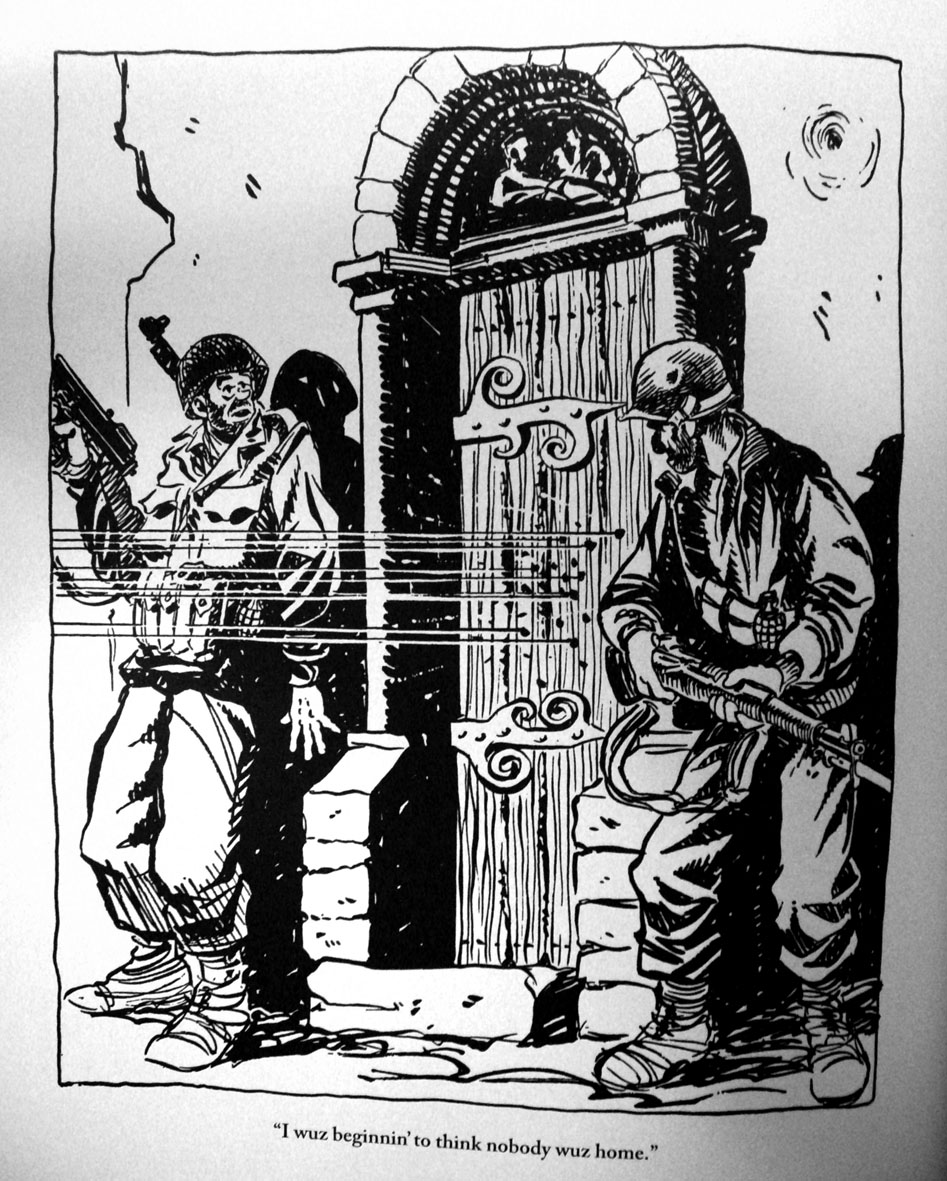
This reminded me of the big pictorial book on World War 2 (1975) by James Jones (of From Here to Eternity). I haven't seen it in years, but I recall that there was a section on War Artists, in which he discussed the art of a particular artist who intentionally used stretched 'heroic' proportions in his figures. I realize that most of this kind of thing will not look strange to the modern reader accustomed to looking at comic books, in which Rob Liefeld once notoriously stretched a figure to as many as fourteen heads (I think Gibbons used the heroic ten heads in Watchmen). Anyway, I forget the name of the artist Jones was talking about, but the strongest candidate is Howard Brodie:


So I'm wondering if Mauldin came into contact with Brodie and or his work in the middle of 1944. Or maybe there's another explanation.
Update. PS- You can see how the heroic proportion brings a gravitas to the drawing that won Maudin the Pulitzer.
10-13-44

earlier post on Mauldin.
Labels: mauldin, new books (3)
posted by Eddie Campbell at
23:14
5 Comments