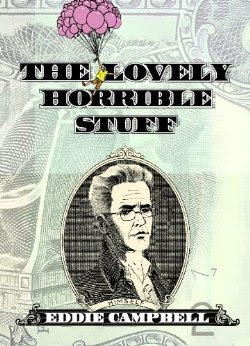
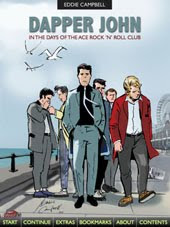
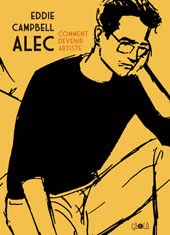
Monday, 16 April 2007

"At his age, his prostate needed all the statistical support it could muster"

M y pal Chalky White asked me to remind you that: "The new issue of the long running Australian anthology DeeVee is listed in the current Diamond Previews catalogue. This stand-alone special features 'tales of spiteful romance' including a brand new Playwright story illustrated by Eddie Campbell plus The Fat Sheila Hit Me, the crime story he illustrated to crime author Peter Doyle's script. Also features work by Jeffrey Brown, Mandy Ord, Jason Paulos, mr j and the pick of current Aussie cartoonists. We're listed under the Top Shelf section and the order code is Diamond APR074012."

The original Deevee was a comic book anthology out of Brisbane that ran for fourteen quarterly issues 1996-2000, during the same period as my Bacchus monthly. Appearing in all of those issues was my serial that became How to be an Artist. Since then the guys, White, Evans and Best, have put out three specials in 2001, 2003 and 2005. In each of these White and I have been developing a new serial titled The Playwright. Thus this new issue offers the fourth part, six pages long, of this intriguing serial. It's all about a chap who writes for stage and tv and has some very tortured sexual frustrations. I established a style for the strip which was supposed to save me time but turned into a special feature of the job, upon which I lavish far too much attention. I blow up details on the photocopier until the pen lines look fat and monstrous and raggedy, then I draw in details on the copy using the finest possible rapidograph. here's an example from the second story in the series, from the hilarious jogging page. There will be more along the same lines in the new story. And I hasten to add that the parts of this serial are not really sequential and can be read in just about any order as they tend to circle around the theme and the character rather than advance in a conventional linear manner..
Also in the new Deevee will be the complete The Fat Sheila Hit Me, a true crime story which I illustrated for an exhibition at the Justice Museum in Sydney. the whole story of that is in the link. This is the moment when she actually hits him:


As you can see, the art turns very savage here. the original was blown up large on a wall. I expect it made an impression.

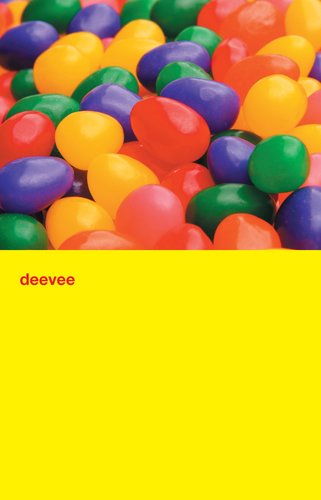
Finally, here's the cover:

********

Interesting connecting links:
My pal John Coulthart posts about Talin’s proposed monument for St Petersburg (which would have been 100 m higher than the Eiffel tower). Follow the ‘dead monuments’ link at the foot to his earlier post mentioning ‘the degraded sculptures made by Igor Mitoraj’ and my pal Nathalie’s link in the comments to a beautiful photo of that artist’s Head of John the Baptist on her own blog.

Labels: ,

Wednesday, 12 August 2009

two more images from The Playwright, the most colourful, sexiest thing likely to ever come from my hand. And if that sentence sounds like one of the Playwright's own double entendres, so let it remain.


Labels: ,

Tuesday, 20 November 2007

the playwright

I'm busy completing The Playwright in a colour edition perhaps for release in 2009. That's the story written by Daren White of which four chapters have already appeared in DeeVee. It will finish at double that length. I'm reformatting it into a small narrow book of single tier strips. I'm enjoying making something special of the colours, since I can apply all my attention to them as all matters of formal construction have already been dealt with. Here are a couple of details:


***********
Joe McCulloch reviews Betsy and Me- This can be a sad, sad book, if you want it to be.
This was a beautiful happy little strip from 1958 whose author, the great Jack Cole, shot himself two months into it.

************
The Guardian- Interview -
Crime of passion
- Sunday November 18- As Britain's bestselling crime writer lays Inspector Rebus to rest after 20 years, the Scottish grocer's son talks about sex, death and binge-drinking, and tells how his son's condition spurred him on to literary stardom. (The last sentence below amused me.):

Anyway, he is not planning to write any more crime fiction for a couple of years because he has other things to do - first, the publicity tour for Exit Music. He is currently doing Australia and New Zealand, followed by Austria and Germany in December. Then he is writing a libretto for Scottish Opera - 'It starts with a bloodbath and ends with a bloodbath, very traditional' - and also a graphic novel, for DC Comics in America. After that, he has promised to expand a serial he wrote for the New York Times about an art heist into a full-length novel, which he reckons will take him well into next year.
He does drink, then? I was worried that maybe, like the smoking, it was exclusive to Rebus. 'Oh, I like a drink! You can see from here,' he says, pointing to a bookshelf entirely given over to bottles of malt whisky, including one his agent gave him dating from the year of his birth. Does he drink every day? 'No. I probably do what is now called binge drinking, which used to be called drinking.

************
Moore, Clowes, Spiegelmaus on Simpsons. Catch it before they remove it. thanks, mr j.


"Maus is in the House!!"

Labels: ,

Thursday, 12 April 2007

The Villains in my Home Town. part 3.

T he technique used for court sketching is usually pastels or some similar quick-sketching medium. But my pal Pete Mullins had gone in using the pantone© markers of the graphic designer, which was an interesting approach I thought. Nobody sets out to make a career of court sketching, or at least I don't think so, therefore it's interesting to see artists from different sub-disciplines moonlighting here. For instance, in many of my images you can tell that I'm at heart a cartoonist. An artist who is on other days a sculptor, or a landscape painter, would approach the task in quite a different way from me.
I followed Pete's lead as I didn't have time to give it much thought (i.e. I was needed tomorrow morning), nor did I have a box of pastels handy for that matter. My own way was very linear to start with; pencil and then tighten that up best I can as after a couple of outings I knew they'd always zoom in on the face. Then I'd take it to the canteen where I could spread out with my tools, outline with a fine marker and then fill with pantone colours based on colour notes I'd made in pencil.


This pair set a sleeping vagrant on fire for a laugh. The man died in hospital. In agony I guess. The boy on left is pixilated because he was underage. There's a paragraph at the foot of an earlier post about the pixilation of faces


Later I started to experiment with a quite different way of making the sketch, by working quickly on ordinary typing paper with Pantones of very subtle muted tints. the paper would be constantly soaked so that the end result had the look of a watercolour painting. And all done with markers. This enabled me to get away from that cartoon look toward something more photographic almost.


But then I missed some of that character insight I was getting in the earlier style.


This man abducted a schoolgirl and raped her.

*****

If my courtroom sketches are starting to make you feel that Australia isn't a safe place to walk about in, check these out. Just in from my pal White, writer of the Playwright and other works of note. This is one of the country's best beaches.


And these are the boys who live on it.


Talking about nasties, we have occasionally in this blog visited the subject of spiders which eat ya. Check out this one, or don't , if necrotic flesh upsets you.

******

From Hayley Campbell: "harking back to your post on Feiffer, THEY'VE DRAFTED MUNRO!"
German army drafts four-week-old baby
Tue Apr 10, 2007 BERLIN (Reuters) -
The German army sent a draft notice to a four-week-old baby named Lucio, ordering him to report for duty within the next 10 days, before realising it had blundered.
******

Youtube: Shat and Joe Jackson perform Common People
(thanks, mr j)

Labels:

Saturday, 10 September 2011

Mandy Ord, last mentioned here yesterday, is a Melbourne cartoonist who has lately been getting some of the attention she deserves.


That wasn't her, but one of her people sketches, which are always caught just right. She is in fact the very attractive lady in this video interview at Melbourne news daily The Age.


She chooses to draw herself as a cyclops. Her book Sensitive Creatures was launched last month August 18, published by Allen and Unwin, who have been cultivating a line of graphic novels, including books by Nicki Greenberg, Shaun Tan and Bruce Mutard.


Oslo Davis, also mentioned here yesterday, writes about Mandy at the Sydney Morning Herald.

Anybody who followed Brisbane anthology comic book Dee Vee (published by my pals White and Evans) will recall seeing her work as early as 2001 alongside The Playwright.

Labels: ,

Friday, 1 December 2006

Look at all the lovely people

Can this handsome man with his beautiful lady wife in front of Times Square possibly be a 'graphic novelist'? Gene and Teresa Yang after the National Book Awards. Gene had the honor of being nominated for his American Born Chinese, in the young readers category. I'd be a runner up in anything if I could be either of the people in that photo (by Mark Siegel, with more of them at First Second Books)
* * *
For all those whose appetite has been whetted by my words and links re. mr j, I give you his latest. Out of context of the series as a whole, it may not be clear that the titular Hayley Campbell doesn't appear in this example. On seeing it she said; "How come the Mammy gets a nose and I don't?" (click for larger)Well, you see, that's one of our tricks of the trade, those subtle techniques we cartoonists use to differentiate characters.

A whole bunch of these strips can be found in the upcoming DeeVee.

The colourful cover above came about when my pal White (who is by day a chartered accountant, you will remember me saying yesterday) said to my pal Evans, the designer, "We're forking out for full color on the cover, so I don't want any of your minimalistic crap." The issue will also contain the next chapter of The Playwright by White and me. We've managed to get out one of these per annum for the last four or five annums. At this rate, by the time we gather it into a book White will be retired and living off his perfectly planned superannuation.
* * *
Here's an odd item. 'Una curiosidad sobre el From Hell.' On Little Nemo's Kat, a Spanish blog; the writer reports on the finding of an annotated copy of From Hell in his local public library. By annotated I mean thoroughly glossed in blue ballpoint pen in the margins, with cross refs to the notes at the back. He has scanned and reproduced a couple of pages. If anyone can ventilate the Spanish better than Google, send me an update and I'll report further (unless it turns out to be dumb of course). (since I jotted this draft I see the writer has responded to the note I left on his blog, in the comments section of my From Hell post.)
* * *
Still on From Hell, Mark Clapham commented...
"Gull Catchers part two? Very tempting. I'm probably not alone in thinking its one of my favourite parts of the book.
The most startling Ripper revelation in recent years was on a recent documentary on the UK's Channel Five, in which a contemporary criminal psychologist was asked to look at the evidence. Her conclusion was that a man who butchered his fellow human beings in such a way probably 'lacked empathy'. "
Revelatory indeed. thank god we have experts. I haven't seen the show but i did read about it. Like Alan said, we've got enough for another 24 pages of hilarious ripperology. It was the favourite part of the book for me and my pal Mullins, where we were permitted to unleash our madcap antics that had been kept very much under wraps till then.

Labels:

Wednesday, 7 September 2011

I have just heard That you can buy Alec: The Years have Pants digitally (15 bucks!). Go to Comixology for your download. Later it will be available in other places, and by the end of the year You can add From Hell and the Playwright to your digital stash. A friend sent a couple of photos of how it looks and you can get a free ten page preview to see if works for you. If you still prefer paper, Top Shelf is having one of its colossal sales right now and you can get the Alec and From Hell hardcovers for only 25 bucks. Go all the way down the list for items at three bucks and even one lousy dollar. One lousy dollar! The guys must have a huge print bill to pay off. Go and lend a hand.


"A digital comic ain't worth the paper it's printed on"- Sam Goldwyn.

Labels:

Wednesday, 21 November 2007

Three more images from The Playwright:


Labels: ,

Friday, 21 October 2011

CLowes' Mister Wonderful is a great read. A whole book describing the events of a single blind date. It took me a long time to warm to Clowes work as I never liked the gallery of grotesques in his early books like A velvet Glove cast in Iron. But from Ghost World on he has been a world class 'graphic novelist'. What bugs me now is that I didn't have the courage to make The Playwright a long horizontal book. I mean look at this; he's got two inches on me:


You see, I was so wishy-washy about the horizontalness of the art that I put padding at the top and bottom of the pages so I could try to slink around the walls of the ballroom without attracting too much attention.


Mister Wonderful is a gathering up of the serial that Clowes made for the New York Times when the venerable old lady was running a 'Funny Pages' section
The section has been criticized for being unfunny, sometimes nonsensical, and excessively highbrow; in a 2006 poll conducted by Gawker.com asking, "Do you now find — or have you ever found — The Funny Pages funny?", 92% of 1824 voters answered "No."
The Funny Pages are no longer published in the magazine.
Mister Wonderful was published a couple of months back by Pantheon. this month Drawn and Quarterly have gathered up his Death Ray (originally published as Eightball #23). he's talking about it at the AV Club:
AVC: How much research do you do to get a time period or a place right? Like in The Death-Ray, there’s a panel in which a character is holding a little photo-cube, which is such a perfect little ’70s décor detail.
DC: Often I’ll do research just to get a time period correct, but I didn’t have to for the ’70s. [Laughs.] That was sort of the height of my powers of observation, those years. I feel like I can close my eyes and still see it so clearly. And that was something I always wanted to do, to capture that later half of the ’70s. It’s like the early half of the ’70s is still the ’60s, in that there’s still kind of a playfulness and inventiveness in terms of design and the things that were going on in the culture. The second half, it got much more commodified. It’s possibly the ugliest era of architecture and clothes and design in the entire 20th century, from 1975 to ’81 or ’82. So I really wanted to capture that, because those were my formative years, and I feel like a lot of my aesthetic was in response to feeling the awfulness and cheapness of that. One of my weekend hobbies is to go look at old houses when there are open houses around here. Just to go look at the architecture. And you can see how many houses were built around 1977, the year where everyone said, “Let’s put in these aluminum windows instead of beautiful hand-made wood ones.”

Labels:

Thursday, 1 March 2007

my books

Thursday, 9 October 2008

artist John Glashan (1927-1999) drew a complicated and unique weekly cartoon in the UK’s Observer magazine titled Genius between 1978 and ’83. In the introduction to the collection John Glashan's World published in 1991 he wrote “It occurred to me that the cartoon form had the potential for something wider-ranging than the three patterns in current usage: the political cartoon, the single joke, the strip cartoon.” I like this because he apparently saw the American comic book and its ambition to become the 'graphic novel' as a separate and unrelated event, a different medium even (as I do). Alternatively it had not impinged on his consciousness at all, which would be difficult to imagine of a cartoonist in the UK in 1991 as the newspapers were full of it, but I prefer to think that he simply wasn't impressed.

The problem with this book is that it doesn't do his higher concept justice, arranged as it is in the manner of conventional cartoon books under thematic headings such as 'money,' 'guilt,' 'love,' fame.' Any reader attuned to the bigger idea would have preferred the pages run in the order the artist made them, and with the goddamn dates attached. But book publishers have never been good at understanding bigger ideas, at least in relation to cartoons, and they still (with few exceptions) do not get them, as I have found in my recent forays into the book world.

But most of my readers are probably not familiar with Glashan and his work. His wikipedia entry will bring you up to scratch, and since i am not being paid to write this blog, I will simply steal it without paraphrase: " Scottish cartoonist, illustrator, and playwright, creator of "Genius". Glashan's cartoons typically included small pen-and-ink figures drawn over a fabulous backdrop often featuring fantastic (Gothic/imaginary) architecture, surreal landscapes, or gloriously impractical ingenious-looking machines. Born in Glasgow and the son of a portrait painter, McGlashan studied painting at the Glasgow School of Art after national service in the army. He moved to London with the intention of making a living from painting portraits, but was unable to do so. Switching to cartooning and illustrating, he curtailed his name to "Glashan". Glashan's cartoons appeared in Lilliput, Harpers & Queen, Private Eye, Punch, and various London newspapers, as well as Holiday and the New Yorker. A series of humorous guidebooks created with Jonathan Routh in the late 1960s allowed extensive expression of Glashan's graffiti-like style, combining small figures (often bearded men) with scrawled text -- but even here, often with elaborate backdrops. In 1978 he took over Jules Feiffer's spot on The Observer magazine and began his strip cartoon Genius featuring Anode Enzyme (IQ 12,794) and his patron Lord Doberman, the richest man in the world. 'Genius' won him the Glen Grant Strip Cartoon award in 1981. This ran until 1983 when he returned to landscape and portrait painting, and from 1988 to 1998 he also contributed weekly cartoons to The Spectator."

Here are a couple of examples of the weekly series, featuring the aforementioned characters Anode Enzyme and Lord Doberman (dates as I said irritably, are unknown to me, though I imagine there must be somebody who collected the stuff as it came out). Another problem with the book is that the things are printed too damn small, two to a page. As I recall, the Observer didn't do them any favours either. They clearly come from the tradition of the gag a day strip cartoon; once the set-up had been established, with a minimum of narrative introduction, the work was an ongoing series of self-contained variations and elaborations. Glashan's sense of a bigger kind of strip cartoon was all about scale. Each of his pieces wants at the very least a full magazine sized page. There's one place in the book where a single painted gag cartoon, not involving any regular characters, is given a double page spread and the watercolours are a joyful ocular experience. Why couldn't it all have been thus? It's no wonder he got out of the business and made a living from his painting. The larger end of his scalar contrast was usually a baronial hall or some baroque improbability:


But in this one he switches it around and an easel painting of a fish is dwarfing his cast of characters:


There is much aesthetic pleasure to be had in looking at the contrast of the typical big painterly image with the sensitive tiny pen drawings. here's a zoom on one of the latter:


The grand scale was also reflected in the characters and the relationships between them. "Anode Enzyme is a genius with an IQ of 12,794. Master of all trades, Jack of none; his impeccable psychic architecture is marred by a single flaw- he has no money." He becomes employed by Lord Doberman, richest man in the world. In a sequence running over several weeks, the first task that is given to the genius is to invent a machine that will fire portable television sets into the sea. "What rate of fire?" asks the genius without hesitation. "Twenty sets per minute," responds Doberman, equally without hesitation.

there's a website

Labels: , ,

Saturday, 8 August 2009

one of the things I've been trying to do with the Playwright, which is wrapped up except for a cover, and will be published in 2010, is to make it the brightest, most colourful book I have ever made. I have had enough of the purply brown. For me the rainbow!


Labels:

Thursday, 20 March 2008

While picking a book off my shelf in response to a comment from a few days back, (On Humour by Simon Critchley) I noticed a couple of other books up there that I haven't thought about in a long time, items I picked up while researching 'the History of Humour'. There's Naughty Shakespeare by Michael Macrone (1998) for instance, (subtitled 'the lascivious lines, offensive oaths, and politically incorrect notions of the baddest bard of all.') and Tailwinds ('The lore and language of fizzles, farts and toots') by Peter Furze (also 1998). Here's an excerpt:

"A married couple had lived together for nearly forty years. The only thing that threatened to come between them in all that time was the husband's habit of breaking wind every morning immediately after waking. The noise would wake up his wife and the smell would make her eyes water. On countless occasions she pleaded with him to do something about his morning flatulations. He told her that there was nothing he could do about a natural bodily function and that she would just have to put up with it. His wife said there was nothing natural about it at all, and if he didn't stop there would come a day when he would fart all his guts out. The husband merely laughed.
Years went by. The wife continued to suffer and the husband continued to dismiss her warnings about farting his guts out. Then, one thanksgiving morning, the wife rose very early and went downstairs to prepare the family feast. It was while she was taking out the turkey's innards that the wife had an idea. Smiling to herself, she put the turkey guts into a bowl and quietly went upstairs to the bedroom. Her flatulent husband was still fast asleep. Gently she pulled back the bed covers, then spread the turkey guts over the sheet, near her husband's posterior. She then replaced the bedclothes and tip-toed back downstairs to finish preparing the family meal.
Some time later the sound of flatulent explosions from upstairs told her that her husband had woken up. Moments later she heard a terrible scream, then the sound of frantic footsteps as her husband ran to the bathroom. The wife laughed aloud. After years of putting up with her husband's morning bombshells she had finally gotten her revenge. But she controlled her amusemant and went upstairs, calling to her husband to ask what was the matter. Muffled cries of 'Nothing, it's all right,' came from behind the bathroom door. Five minutes later, her husband emerged, a look of horrror in his eyes. The wife began to feel rather sorry for him, and again asked him what was wrong.
"I didn't listen to you," said the hiusband. "All those years you warned me and I didn't listen to you." "What do you mean?" said the wife, innocently. "Well you always told me that I would end up farting my guts out, and today it finally happened." The wife was about to put him out of his misery and admit to her prank, but her husband continued: "But by the grace of God and these two fingers, I think I got'em all back in."

********
Coincidentally, my two most regular suppliers of links have sent me stories about toilets today.
Olympics crisis over squat loos
BBC NEWS- 19 Mar- China is rushing to install sit-down loos for its 500,000 foreign Olympics visitors, after complaints that venues had only Asian-style squat toilets. (via wee hayley campbell)

Noir Thriller Plays in Public Bathrooms
NEW YORK (AP) -19 Mar- For most visitors to Central Park, the public bathrooms are a facility of last resort, visited only in desperation after consuming one too many cups of coffee. They're dark and creepy, filled with spiders, foul odors and puddles of questionable origin.
But for Irish director and playwright Paul Walker, the damp, the chill and even the smell are all part of the experience - the theatergoing experience.
His prize-winning play, "Ladies & Gents," is a noir thriller performed entirely in the covered men's and women's bathrooms in Central Park's Bethesda Terrace.
The space is intimate, unpretentious and uncomfortable. Walker's previous site-specific plays involved busing bewildered patrons to an abandoned warehouse, and a play that meandered through all the rooms of Dublin's Sick and Indigent Roomkeepers Home...
(via Bob Morales)

Labels:

Wednesday, 13 August 2008

the other panel I was on at the San Diego con, the "World of Graphic Novels," on the 25th July, moderated by Tom Spurgeon and "featuring Nick Abadzis, Eddie Campbell, Alex Robinson, Rutu Modan and Adrian Tomine," was audio-recorded and is available for downloading until the end of August at The Comics Journal, see top of page. It was here that I made the point that the librarians and to some extent the book trade have decided that the graphic novel is a young readers' genre. A librarian in the audience made the case that this is a good thing. But here is the sequence of events: circa 1980 it was decided that comics had grown up and the grown-up version would be called 'the graphic novel.' This has been forgotten and a recent article in the Christian Science Monitor (June 27) declares:
"Graphic novels, all grown up". In other words, we're right back where we started.
It's all well and sweet for the librarians to rejoice at getting the kids back reading actual books, but if you read my recent exercise in High Sarcasm, the Publisher's Weekly interview of June 17, which my pal White thought my funniest moment in print, you will have noticed I accidentally dropped my guard at the end and confessed I've been having great difficulty selling my latest book (a problem lately solved so do not weep for me). This work is described as "The Playwright, a book about about the sex life of a celibate middle-aged man." In the same period I've been pitching that around the place, two of the publishers who turned it down then said they'd still love to work with me and offered me the jobs of illustrating to the scripts of named 'young readers' authors.
It's also worth noting that Lynda Barry, to whom I was runner up in The Journal's best comics of 2002 list, has in the interim been experiencing the same difficulties. See Tom Spurgeon's interview with her

LYNDA BARRY: Well, in my situation, until Drawn & Quarterly came along, I couldn't find a publisher who was interested in my work at all. There was no one. I'd been working with a small publisher in Seattle called Sasquatch, but after One Hundred Demons, they didn't want any other books from me. I'd always planned to do a sister book to One Hundred Demons that was about the writing process, and always intended to do it with them. When I pitched it to them, they said no, and no to any other books of comics. The End. That was it.
I never understood why, exactly, because I think One Hundred Demons did OK for them, sales-wise, and I believe my other books have done fine too. So it made me feel pretty bad. The same thing happened with Cruddy. After it was printed, Simon & Schuster wasn't interested in another novel from me. But in that situation my original editor left and I didn't know anyone else there, and it was a little bit more understandable. So really, there was a long period where no one wanted to print my work at all.
I can't recall how exactly it played out on the day, and I can't bear the sound of my own voice enough to listen to it (I've just discovered I have a Scottish accent... why didn't somebody tell me?), I but I recall Nick Abadzis throwing in his two cents on the subject. In fact, I remember the panel being an engagement of the better sort, in which the participants got a decent conversation going. Too often these things just involve each party in turn telling the audience what new stuff they have for sale.
(update) Curiosity got the better of me and I checked the first couple of minutes. I had completely forgotten that I poured Spurge a glass of water to my right, then after pouring another couple to my left returned to give him a second cup, putting it on top of the first and spilling it all over the table, with electrical wires floating in it and all. It was halfway through the set before one of the officials noticed Spurge was virtually paddling in it.
*************
speaking of grumbly artists (in the 'children and teenagers' part of the Guardian's book section, appropriately):
"Raymond Briggs lives in deepest Sussex, in a small, white house that has more draughts and rickety bookcases than your local underfunded library. I can't understand it. This is the age of JK Rowling. Shouldn't he be living in ... 'What?' he says. 'A mansion?' Yes. Surely all those Snowman tea towels must have had some effect on his bank balance. 'Oh, I don't know where that money goes. It's a grey area. Someone buys the rights to do these things and then, after everyone else has taken their share, tuppence ha-penny comes out at the end for me"
*************
Giant dog turd wreaks havoc at Swiss museum

A giant inflatable dog turd created by the American artist Paul McCarthy was blown from its moorings at a Swiss museum, bringing down a power line and breaking a window before landing in the grounds of a children's home. The exhibit, entitled Complex Shit, is the size of a house. It has a safety system that is supposed to deflate it in bad weather, but it did not work on this occasion. (via wee hayley campbell, who thought it the best headline ever).

Labels:

Tuesday, 6 September 2011

There's a review of Alec:The years have pants in the newly published Comics Journal #301. Its writer, musing upon a slickness he perceives in the art of the later portions of the book, concludes that it must be because of my 'acknowledged use of assistants.' He offers that explanation rather than the more obvious one that a worker in any field is likely, barring the burdens of ill health or senility, to acquire, by degrees, a facility in his work after practicing it for ten, twenty, and then thirty years.

I handed it to him in a panel in the book itself, if he got as far as page 259.


However, more pertinent to my reputation, anybody who ever did any work on a story of mine always got his or her name on it. There were one or two exceptions which arose when, if another set of hands was involved, another set of contracts were going to have to be read, signed and mailed. In these circumstances we saw it, much as we were honoured to be involved, as a job to be executed quickly and with the least hassle. That happened maybe twice and on one of those I got Pete Mullins to letter his name onto a bottle in the foreground of a panel.

Assisting a professional working comics artist is something I would have loved to have done when I was starting out. I even offered myself to one, but he didn't have the type of personality that would have lent itself to such an arrangement (he would undoubtedly have murdered me within a week). The practice has existed since the early days of the newspaper comic strips. In the very earliest period, a young fellow would work as a cleaner and gopher in the art room of a newspaper and work his way up through colouring and other such routine jobs. Then when cartoonists started to become stars and get to work at home, they would hire a young wannabe to assist. The job involves so much routine labour such as cutting and ruling paper, posting and collecting mail etc., that it was an arrangement that suited all involved. Eventually the young guy, if he proved himself both useful and talented, would get to work on the important parts of the job, and eventually get a leg up into the business on his own account. The comic books favoured a very different arrangement, closer to a factory assembly line, in which the job of making pictures in a comic book is broken down into clearly delineated activities under the headings 'layout,' 'pencils', 'inks', 'colors.' It grates me to find that many comics aspirants think of this as a natural division of labour rather than as something cooked up by the sort of people who set their minds to inventing ways to make hens lay more eggs than hens are naturally inclined to lay.

It would irritate me when that kind of thinking would turn up in places where it really didn't belong, such as Harvey Pekar's early books, where he would have a single page story with a credit box giving himself as writer, with Dumm and Budget as penciller and inker. I thought it was unseemly to have that many names on a one-pager. I thought it belonged on the packaging. Imagine if you got credits for a song actually heard in the recording instead of printed on the sleeve notes. My way of doing things was to just scribble my name next to the story title and if somebody else worked on it, then add their name under mine. Like this:


In the early 1990s I found my self able to line up way more work than I could handle. And way out here, remote from the comics publishing biz, there were enough people who were desperate to get a taste of it that I would have felt like a criminal to turn any opportunity away. But my feeling was always that this was my thing, and I'm the author, and anybody contributing to it is a guest writer or guest artist, and my way of implying that was to simply add their name after a '+' or a 'with'.

There was a fellow who wrote a few things for me who used to get mad at me because I didn't put 'writer' or 'co-writer' by his name. He didn't want people thinking he was 'just an inker' (as in 'tracer'). I told him if he wanted to use the work to get himself other work, I'd happily back him up in however much of it he wanted to claim for himself, but I wasn't putting it on the page. There was another fellow who came round when I put the word out I desperately needed help on a job. He said he didn't want to be 'just the inker'. I replied that I didn't work that way but, to be frank, I told him I wouldn't trust him to ink it. We got on fine after that. I even got him to draw a number of foreground figures when the deadline loomed.

I look at the practice of getting help on the work as comparable to a singer-songwriter hiring backing musicians. There are times in comics when extra hands are like the ingredients in a fine soup or a rich stew. It makes it all more interesting both to make and to read. I can see many places in From Hell where my attention was flagging, and I thank Fate that Pete Mullins was on the premises to keep me from looking foolish, artistically speaking. And there are loads of funny ideas in Bacchus that Marcus Moore threw in, and they still make me laugh today. And Mick Evans did all the design stuff when I thought myself a publisher, and Daren White hung around long enough to get properly recognized on the Playwright. But the Alec stuff was always different. That's my personal view of everything. It's all mine.

Labels: