Wednesday, 22 October 2008

musician plays his banjo while having brain surgery. (Two minutes of video of the performance.)
A musician who underwent brain surgery to treat a hand tremor played his banjo throughout to test the success of the procedure.
Eddie Adcock is one of the pillars of Bluegrass Music and realised his tremor could threaten his ability to perform professionally.
Surgeons placed electrodes in Mr Adcock's brain and fitted a pace maker in his chest which delivers a small current which shuts down the region of his brain causing the tremors.
(link thanks to Bob Morales)

Labels: ,

Wednesday, 15 October 2008

we had a great night out at the Powerhouse last night seeing Brisbane band the Doch Gypsy Orchestra in their fifth annual appearance there. Here's a glimpse of them from Youtube, I think from last year, though this must be a different venue, as it seems to be on the verge of turning into a roman orgy and I don't recall that happening anywhere I've been, though the wife of my bosom says that my presence automatically puts a damper on that kind of thing:


There was less hi-jinx in the string section this year, which i noticed because I look out for it. Doch always gets in a roundup of extra musicians for the Powerhouse big-band version of their thing, such as local master of the show-off violin, Shenzo (Shenton Gregory), seen in this clip from last year, or the year before, playing a three minute cadenza:


Here's Shenzo with his own band, the Electric Stunt Orchestra, backing the weather forecast for the TODAY program. Paganini never played the James Bond theme hanging upside down from a concrete flyover

Labels: ,

Wednesday, 8 October 2008

they've been using this song in a Volkswagen ad here in Australia and three nights running I said to myself I must find out who that lady is. It's Little Waltz by Basia Bulat, Canadian singer songwriter. Here's a live performance of it.


First few lines of Lyrics for Little Waltz
© Basia Bulat
"You and I, we make a grand salute
stare at each other like lost little birds across the room
and I remember the way you looked
I learned how to dance, but I’d never shown it to you
My love, I know I was wrong,
but you know that you’ll always be
my love..."


her website

Labels:

Wednesday, 21 May 2008

my attention has been drawn by my pal Bob Morales to the fact that Melbourne comedy band Tripod can be seen on Youtube. Here they are with the Umbilical Brothers doing 'Air Guitar'. The second piece is titled 'Hot girl in the comic shop' (or comic store as they say in the US) and I expect some of my readers will get a laugh out of it. These are from the band's regular spot on ABC's Sideshow last year.


Labels:

Wednesday, 7 May 2008

department of stuff found in pocket:
one beermat, Squires' Amber Ale. I just love this piece of design. And the beer's not half bad either. You may not be like me, a fellow who could be persuaded to choose one airline over another based on something as inconsequential as the beer they serve inflight. If you are, note that Qantas now offers both the Amber and Golden Ales from the Squires range, in the can, and on most flights I think there's a charge. But then again, you might crash anyhoo, in which case money will be of no use to you.
*********

Before I leave the subject of my sojourn in Melbourne. On the plane, Dan in Real Life (from last October, but released here in feb 2008), a great movie, starring Steve Carrel, with a set of bloody brilliant songs by a fellow new to these ears, Sondre Lerche. Now, I don't mention music here much because the current lot of it bores me to tears with all its falseness of phrase and pose and dress, but I'm climbing on this guy's bandwagon. Here's an interview from last October and here he is singing 'Modern nature.' He also sings it on-screen in the final scene of the movie, but don't go looking for that or you'll spoil the ending.

Labels: , ,

Monday, 28 April 2008

humphrey Lyttelton delivers swansong with giant kazoo band- Sunday Times - April 27, 2008

Humphrey Lyttelton, the jazz trumpeter who became doyen of the double entendre as chairman of the quiz show I’m Sorry I Haven’t a Clue, is to make a bid from beyond the grave to enter the record books as leader of the world’s biggest kazoo band. Lyttelton, who died on Friday aged 86 after heart surgery, equipped every member of the 3,550-strong audience with a kazoo at a live version of the radio programme earlier this month at the Hammersmith Apollo in London and encouraged them to hum into the simple instrument.

*********
(via Heidi)
The Project has very simple parameters and it basically works like this: Men who are open to being given a swift kick in the balls need do nothing. Women will simply assume that any man not clearly indicating his position vis-a-vis being kicked in the balls with an approved OSSKBP badge or pin is open to being kicked in the balls, as any progressive, free-thinking, feminist man ought to be, by any woman who wishes to do so.
However, we also recognize and affirm that not all men will be so willing to serve. Therefore the OSSKBP provides two other options.
1. Men who would like to be asked for permission before a woman administers one or more swift kicks to their balls shall wear the offical OSSKBP "Ask First Pin" at all times...

Labels: ,

Saturday, 22 March 2008

Pachelbel; his canon.

Johann Pachelbel - 1653-1706
Canon in D
"arguably the most widely used, recorded and recognizable instrumental work of all time."

I shan't argue with that, but I am curious as to how it got that way. My CYCLOPEDIA (sic) of MUSIC and MUSICIANS, edited by Oscar Thompson , third edition, revised and enlarged, of 1944, gives ten lines on the composer but doesn't mention the Canon in D. or more properly, Canon and gigue, for 3 violins & continuo in D major, T. 337. A canon is of course a type of contrapuntal composition once popular, in which the theme is imitated by a second voice at an interval, and more voices after that if you like, though as with most things in the world it is a little more complicated than its one-line explanation. And a gigue is a jig. Here's a list of over 500 other works by the composer.

So how did it get to be so famous after so long, about 250 years after the death of the bloke who wrote it?

8notes.com has tracked its rise to favour by counting the mentions of it in the NY Times, an ingenious idea I thought (see right). So something happened in the '60s, and it picked up a head of steam in the '80s.

All music guide notes that Mr Pachelbel was

lost in the mists of musical time until Rudolf Baumgartner and the Lucerne Festival Strings decided to record a work they called Pachelbel's Canon for France's Erato label in the mid-'60s. The recording was not considered worthy of release domestically in the United States except by the Musical Heritage Society. Amazingly enough, the recording became a best seller and, even more amazingly, was heard by Robert Redford, who decided to use it in his film Ordinary People (1980). From there, for a brief time, Pachelbel's Canon became the most popular piece of classical music in the history of humanity.
I have tried and failed to find any anecdotal information about Mr Pachelbel except for a couple of incidents at a slight remove from the man himself
"One interesting story comes from his time in Ohrdruf. For some unknown reason, Johann Christoph Bach (older brother and teacher of JS Bach) forbid J.S. from reading a manuscript of Pachelbel's original works. Every night for six months, Bach would sneak down to his brother's study and copy the manuscript by moonlight for his own use...
He also tutored all of his children. His son William Hieronymus filled Pachelbel's position at Sebalduskirche, shortly after his death. His other two sons, Carl Theodor & Johann Michael immigrated to America around 1730.
While in America Carl Theodor made a bit of history. Following in his father's footsteps he found employment as an organist at the Trinity Church in Newport, Rhode Island sometime around 1733. In 1736, he traveled to New York City and at 6:00 PM on January 21, 1736 gave a concert in a local tavern. This event is significant as it was the first concert in the colonies of which records exist.
Now, before I post the celebrated Youtube video of a version of the work which I rather like, note the following:
Originally written in 1700 (elsewhere given as early as 1680) as a short, fast piece for three violins and basso continuo, the Baumgartner recording set the pace for outlandish arrangements of the work by slowing it down to about a third its original tempo
And that's the respectful version we're talking about. There are hideous disco and techno beat renditions out there.

What would Mr. Pachelbel think about it? I wonder if you stop caring when you're dead, or if there really is an afterlife and God lets you in on the Cosmic Joke and you just spend the rest of Eternity laughing. Who knows? I suspect Pachelbel would be too horrified by US to even get around to considering what we'd done with this canon out of all the canons he wrote. Nevertheless, this is Taiwanese Guitar virtuoso Jerry C. playing it (in one of the most popular videos on Youtube over the last couple of years). Of course it is no longer technically speaking a 'canon,' and whether the dramatic key shift at 3.53, creating the modern 'bridge' that facilitates its conversion into a rock anthem, originates here or in the work of a slick arranger in some other version, I do not pretend to know and haven't the time to find out. But this kid sure can play.


(Youtube link from Callum Campbell)

Labels:

Friday, 22 February 2008

Today I watched Sophia Coppola's Marie Antoinette. I don't understand why the Wikipedia entry has described it as 'lightweight", nor why it might have been booed at Cannes, nor why it had trouble at the box office, but then I don't understand why i have trouble either. What a magnificent film. I give it two of Ebert's thumbs and three of my own. And the soundtrack! Take a bow, Jean-Philippe Rameau, take a bow, Francois Couperin, take a bow wow wow.


**************
I can't find a name on it or around it, but the guy who draws 'Duty Calls"made me laugh. Go and see if he's got any more.


Update: That's Randall Munroe's work. thanks, Auz.
(via weehayleycampbell)

Labels: ,

Wednesday, 13 February 2008

The sixties.

The well known exchange of dialogue from the movie Field of Dreams (1989) stuck in my mind for a long time:
Annie Kinsella:"...And if you experienced even a little bit of the sixties, you would feel the same way, too."
Beulah: [indignantly] I *experienced* the sixties.
Annie Kinsella: "No, I think you had two fifties and moved right into the seventies."

I spent the entire sixties in captivity, since the ends of the decade correspond to my ages of five and fifteen, so I guess I missed the fun part, at least in the ways that I measure fun from my present perspective. However, while I am suspicious of sentimentality for the past, It would certainly be true to say that there was something special about the sixties, from the point of view of an artist. In tandem with picking up and watching Godard's A bout de Souffle (1960) I was recently reading a book one of me pals gave me for my fiftieth birthday two years back, Revolution! :The Explosion of World Cinema in the 60s, by Peter Cowie and I got to remembering how there was a time before film properties were thought of, in the terminolgy of business, as 'franchises.' That was way back when a fellow whose name I have forgotten used to take me along to seasons of Welles and Hitchcock at the National Film Theatre and I had half a notion of getting into that world, the Art of Film.

To save us all having to spend undue amounts of time excavating the ruins of that age, there's a blog doing the work for us: The World Of Kane: 'Retro candy for your eyes and ears.' It's the work of Will Kane, whose myspace shows him to be 38. His obsession with sixties is the itching, driving, all encompassing obsession of one who arrived just as they were closing the doors. Here he gives us a beautiful set of images of Vasarely's op-art paintings, and here's Sammy Davis and Anthony Newly in what looks like a Hefner setting, which is all a bit self-congratulatory and self-conscious, but I'd never seen it before, and anyway I seem to remember that being the gestalt of the sixties.

Much more precious are the three Youtube clips of Jacques Brel, a true artist who died before he was fifty.. Especially look at his 'le moribond', horribly massacred in English as the syrupy "Seasons in the Sun."
(superior direct translation of Mort Shuman)
"Goodbye Antoine, I didn't like you very much,
I am dying of dying today,
but you are full of life and more soild than boredom
...seeing that you were her lover I know that you will take care of my wife.
I want you all to laugh, all to dance, all to enjoy yourselves like crazy,
when they drop me in the hole."

and Amsterdam:
"In the port of Amsterdam there are sailors who dance,
rubbing their bellies against womens' bellies,
they turn and they dance like suns spit out,
to the sound of a rancid accordion."


Kane has been collecting the sixties since Oct 2005, so there's a lot of browsing to be done. His latest post is about comic book stylist Jim Steranko. He shows the famous censored page from SHIELD #2, but the supposed original version has always looked bogus to me, with that clunky drawing of the figures, as though Jim concocted it after the event just for a good yarn. The way it was printed looks superior to these eyes. In an earlier post Kane has scanned the whole romance story that Steranko drew.
(thanks to drjon for the link)


****
One of my regular correspondents emailed and asked me to explain the 'asscrusher' story from my Feb 11 post.

Tony Consiglio was working in an appliance store and got a phone order for an 'asscrusher' from a lady down South
The great thing about Tony's telling of the story is that he strings it out for ages and the listener can't get it, so this is the very short version:

"Lady, if you don't mind me asking, what do you need an asscrusher for?"
"Are you making a fool of me? you need an ass-crusher to crush youah ass!"

Tony keeps trying to find ways to clarify the query, until finally it clicks:

"And when you've crushed it, where do you keep your ass."
"Are you stupid, mister? You keep youah ass in the ass box to put in youah drinks."

(I've been tampering with the phonetics in the above all day...sigh...)

Labels: , ,

Tuesday, 13 November 2007

‘Why doesn’t somebody take this goddam thing away from me?”

Continuing the Thurber theme here at Campbell blogspot, I’ve been reading Burton Bernstein‘s 1975 biography of the great man. There’s alway that dreary part at the beginning of the ‘life’ where you have to wade knee deep through a swamp of forebears. I find with this book that I’m not doing my usual speedy dash through the first chapter but relishing every detail:

Aunt Kate’s benign conventionality marked her as the odd one in the family, for her myriad Matheny and Taylor relatives wee a cast of certifiables. As Thurber read the roster, there were, for example: “Aunt Lou, who wrote poetry and believed that everything was for the best; Aunt Melissa, who knew the bible by heart and was convinced that Man’s day was done… Aunt fanny, plagued in her old age by recurring dreams in which she gave birth to Indian, Mexican, Chinese, and African twins…” and one of Thurber’s favorite Ohio creatures- “Aunt Florence, who once tried to fix a broken cream separator on her farm near Sugar Grove and suddenly cried, ‘Why doesn’t somebody take this goddam thing away from me?” then, too, there were the likes of Aunt Clemmens, a loony mystic who smelled dire conspiracy in such disparate phenomena as the sinking of the Titanic and the invention of electricity, and perhaps the queerest of the lot, Aunt Mary Van York, a wisp of a woman who survived till ninety-three mainly on a diet of an estimated two hundred thousand pipefuls of vicious Star plug chewing tobacco.

*******
I'm reminded of the song, Family Tree by Jake Thackray (seven verses with guitar tab):
Up my, my family tree
There hangs my curious pedigree,
My long, my lurid ancestry -
The prancing phantoms and ghosts
Of my rude forefathers.
Nevertheless, despite their sins,
Bless my kiths and bless my kins.
There they all perch to see
Up my, up my family tree.

Up my, my family tree,
No blue blood, no nobility;
No trace of aristocracy -
Except for Uncle Sebastian
Who once raped a duchess.
Nevertheless, despite their sins,
Bless my kiths and bless my kins.
There they perch for all to see
Up my, up my family tree.

whole website devoted to the late singer/songwriter

Labels: ,

Tuesday, 6 November 2007

"Michigan Water tastes like Sherry Wine"

This one's for my pal Pam Noles.

I was listening, while working, to the tv playing in another room when I heard a current ad for babies' nappies, or diapers as they say in USA, using the old song Pretty Baby, and I got to thinking about how that must be one of the most enduring of 20th century songs.
Dean Martin recorded it,and sings it here, in case you just flew in from Uranus don't know the number.
It was written by a New Orleans pianist named Tony Jackson (pictured left in the only circulated photo) sometime before 1916, which is the date it was published.
Tony Jackson was born to a poor African American family in Uptown New Orleans, Louisiana on June 5, 1876. Fellow musicians and singers were universal in their praise of Jackson, most calling him "the greatest". Jackson also wrote many original tunes, a number of which he sold rights to for a few dollars or were simply stolen from him; some of the old time New Orleans musicians said that some well known Tin Pan Alley pop tunes of the era were actually written by Jackson. Jackson dressed himself with a pearl gray derby, checkered vest, ascot tie with a diamond stickpin, with sleeve garters on his arms to hold up his cuffs as he played. This became a standard outfit for ragtime and barrelhouse pianists; as one commented "If you can't play like Tony Jackson, at least you can look like him". One of the few tunes published with Jackson's name on it, "Pretty Baby" came out in 1916, although he was remembered performing the song before he left New Orleans. The original lyrics of "Pretty Baby" were said to refer to his male lover of the time. Jackson unfortunately never recorded.

That's a shortened version of the Wikipedia entry. It doesn't say much more than that. There's a separate entry for Pretty baby, and a history of the song here (scroll down), with particular reference to how the names of others got on the credits but apparently don't really belong there.


Finding more info about Tony Jackson and any other songs he wrote isn't easy. I found this great image of a piece of sheet music, I believe from the same year as Pretty Baby, 1916, with lovely cover illo currently at an online Antique sale..


The most comprehensive account of the man I know of is Martin Williams' three pages on him in Jazz masters of New Orleans, 1967, which at least gives us a few other song titles: Baby, I'd love to steal you, When Your troubles will be mine, Some sweet day (louis Armstrong recorded this in 1933, but retrieving a lyric from a Satchmo performance is often impossible; he scats through at least one verse), Such a Pretty thing, and The Naked Dance (a bagnio specialty remembered and played by Jelly Roll Morton during his Library of Congress recordings)

There's also Michigan Water Blues, which has been recorded by several performers of late I think (Michigan water tastes like sherry wine, Misissippi water tastes like turpentine,) and the anecdote about politician Kenneth Keating who said (1959) 'Mr President, i should like to offer a small historical footnote to the current debate with respect to the Lake Michigan water-diversion bill. Frankly, I do not know at this point whether Michigan water tastes like sherry wine, but even if it should, that would still be no justification for diverting it to the Chicago sewer system'

Long time readers of this blog will smirk with amusement as I include this last bit, history's inevitable mockery appended to an obscure artist's meagre biography, "Jackson's death at forty-five in april 1921 was rather bizarre, the result of a seizure of eight weeks of the hiccups which the efforts of doctors could not relieve."

Labels:

Thursday, 18 October 2007

The man who drinks.
(the other one)

There's not many things that will get Campbell out of an evening these days. There's the Doch Gypsy Orchestra, and, well I can't think of anything else right now. Doch is a small band of half a dozen players with three albums stacked up since 2002, but once a year they play a week at the Brisbane Powerhouse with an expanded band of around twenty five plus a couple of foreign guest singers. (Over two dozen classy musicians on stage all at once!!). They are one of Brisbane's treasures, a young outfit of astonshing musical ability. I first heard of them a few years back when wee hayley campbell phoned from the Queen Street pedestrian precinct shouting 'Dad, there's a band playing here. You gotta hear these people!' I've pinched this picture from the Brisbane Powerhouse site, which is also on the cover of the DVD recording titled THE MAN WHO DRINKS (can't find it for sale online, but that doesn't mean it isn't there) of their 2005 appearance at the venue, except that on there it's in greys and the design, brown on olive green, looks like they don't care much whether you buy it.


Take it from me it's an uproar of joyful music played by beautiful people, and it's exactly as I recall the night except there's only half of it on the disc. Also at the Powerhouse site there is a great video clip of this year's guest singer laying it on thick with intricate guitar accompaniment, a moment for which the wife of my bosom expressed immediate fondness, though it is not the band's typical style. The opening of the Dvd goes like this taster at YOUTUBE. From elsewhere, here's the small band doing Kiberee. And ten minutes from their New Zealand tour, with talk, explaining, rehearsing, great shots of N.Z. itself. Singer/ trumpeter Michael Rogers has a cheeky, engaging personality. They're at the Powerhouse till Sunday, but I'd be surprised if you can still get a seat, and that'll be me staying in till next year, unless they turn up unexpectedly at some other venue.

Labels: ,

Tuesday, 16 October 2007

Jelly Roll's murder ballad

O ne of the most extraordinary sound recordings ever, was made when Alan Lomax brought Jelly Roll Morton into the studio in 1938, nearly seventy years ago. Morton was effectively washed up as a musician, now working as a manager, bartender and bouncer in a Washigton DC bar. In his heyday he was a pianist, song writer, vaudeville performer and made a bunch of pioneering jazz recordings in the '20s. Lomax "was an important American folklorist and musicologist. He was one of the great field collectors of folk music of the 20th century, recording thousands of songs in the United States, Great Britain, the West Indies, Italy, and Spain." I have a cd of 'Scottish drinking and pipe songs' he produced on location somewhere, but there's not enough notation in the booklet. I also have his "The folk songs of North America" compilation of 1960. The location was the Coolidge auditorium of the Library of Congress and the sound was recorded on equipment that was never meant for commercial recording. "The sessions, originally intended as a short interview with musical examples for use by music researchers in the Library of Congress, soon expanded to record more than eight hours of Morton talking and playing piano." I got this stuff when it was four discs, but I see it's lately been issued complete on seven. The thing about the recordings is that Morton was persuaded to leave in all the raw language. There's a somewhat charming moment where he hesitates but Lomax and his female stenographer assure him it's okay. The centerpiece of the whole thing is a half hour epic called The Murder Ballad, an extended blues played and sung movingly by Morton. It was recorded on seven discs, four and a half minutes on each, with Morton vamping on the piano during changeovers. It is one of the most tragic, hardbitten, mesmerizing things I have ever heard. Doctor Jazz has the sessions transcribed here including the Murder ballad, though as in all blues, seeing it written is only of academic interest beside hearing it performed. Nevertheless, these are four of the sixty one stanzas:

Time is comin’ that a woman don’t need no man,
That’s what she said when she was in jail.
Time is comin’ a woman won’t need no man,
You can get it all with your beautiful hand.

They went to sleep that night, the other gal crawled in her bed,
They went to . . . sleep that night, the other gal crawled in her bed,
She says, “I’m goin’ to get some of this cunt, you bitch, I said.”

Years and years I could take a prick just like a mule,
I could take a great big prick just like a great big mule,
I found out what a big damn fool.

I hustled night and day for that man of mine,
I hustled day and night for that man of mine,
Now I’m through, I’m behind the walls for a long time.
Three years later he was dead, aged either 50 or 55, depending.

*******
Message from Nicki Greenberg:
"I see you're at it again on the blog... flogging the horses of the Bayeux Tapestry!"
Yes, I've desperately tried to change the subject today.
All the same, thanks for roning.

Labels: ,

Tuesday, 2 October 2007

Picked up a cd today. Another for my pile by the eightheenth century composer, Le Chevalier Saint-George. (1739-99). He gets a three line entry in a 1944 encyclopedia of music on my shelf. However, in the last seven years we have had Alan Guede's 2003 biography of the chap, and a group of enthusiasts campaigning to have the reputation of the black composer, son of a slave mother and an aristocrat come to Guadeloupe to seek his fortune, thoroughly revived. The result is that a street in the historic center of Paris between Concorde and Madeleine is now named after him. Getting a a comic strip artist to draw the cover of the Cd booklet strikes me as an odd move.
**************
Following my mention of Guy Davenport yesterday, I'm ashamed to say that I find that I missed an excellent essay on hs work by my fellow enthusiast Jeet Heer in the Comics journal #278. He was kind enough to send me a copy of it. If he gets it up online I'll link later, but in the meantime here are a few lines:

Like "Tatlin!" all of Davenport's illustrated stories are inventions. The pictures never serve simply to replicate what is in the words but rather add new information or a fresh perspective. These illustrated stories paralleled and anticipated some of the experiments of writers like Donald Barthelme and W.G. Sebald (kissing cousins in Davenport's literary universe.) "It was my intention, when I began writing fiction several years ago, to construct texts that were both written and drawn," Davenport noted in the introduction to his 1996 book Fifty Drawings, a gathering of his fugitive pen-and-ink work. "In my first work of fiction, "Tatlin" (1974) I drew careful replicas of works by Vladimir Tatlin that exist only as poor reproductions. These were meant to be as much a part of the story as my narrative and required more time to do than the writing. No critic has commented on them, as seeing and reading are now alienated."
'as seeing and reading are now alienated'. Let's think about that.

Labels:

Wednesday, 6 June 2007

"Kiss my backside." (wrote Mozart.)

The confluffle over cartoonist Bill Leak's appropriation of Tintin in his caricature of Australian politico Kevin Rudd has been resolved.
The Australian, Jun 04, By Peter Wilson in Brussels:
THE Belgian firm that owns the copyright on Tintin has conceded Bill Leak is free to portray Labor leader Kevin Rudd as the cartoon character
in The Australian, but says he cannot "commercialise" the image by selling copies to the public. Leak last night responded to Moulinsart's latest statement saying: "I'm not a lawyer, I'm a cartoonist. I poke fun at people for a living. I'm sure Herge would have approved".

The incident has reminded me of one of my favourite CDs. It's Mozart Unexpurgated, an Australian recording by The Song Company on the Tall Poppies label, 1991, with a cover by the same cartoonist showing Mozart sitting on the dunny with his breeches around his ankles, while scrawling on the wall. The disc gathers together all of Mozart's rude songs, and other songs in no way rude, which he composed for singing among his friends and family. They are translated to English and fit the tone of his letters, which are delightfully peppered with scatalogical nonsense (well served by Spaethling's recent translation).
The disc opens with these lines in gorgeous six-part haromony:
Kiss my backside
Goethe said it in his drama,
second act, you know the scene quite well!
Here's a catchy commentary,
Mozart now is literary!

And the words crap, fuck, fart and shit all put in appearance. It's all beautifully musical of course, and the 12 part harmony of "V'amo di core teneramente" (nothing rude in this one) never fails to reduce me to tears of joy even though it is only 1.12 minutes long.

glossary: The phrase 'tall poppies' is worth a word of explanation: "The tall-poppy syndrome refers to the behavioural trait of Australians to cut down those who are 'superior' to them. It is used to explain why most politicians, some academics, and the occasional millionaire, command a level of community admiration inferior to that of a toilet cleaner."
I and the boon companion of my self publishing years, Pete Mullins, once conceived a chronically self-defeating character whom we named 'the small poppy', and we went so far as to draw a few sketches. But we dropped the idea on the grounds that the greater part of our market, the USa, would probably not 'get' the phrase, and furthermore that from the way we'd drawn it, the person it was based upon would more than likely recognize himself.
'dunny' is self explanatory, but I'm amused to see it has a Wikipedia entry.
*************
Allan Holtz has some grand old Los Angeles political cartoons from 1906 by George Herriman, after finding a microfilm stash at his library. I expect there will be a few who will complain that they don't mean anything if you don't know about the parties being ridiculed, but I always find that those complaints come from folk who also need today's paper explained to them. The art of political cartooning has been using the same kinds of meatphors for centuries. The appeal is seeing the variations, and the additions. Did you need to know who Kevin Rudd is, or who Bill Leak is to enjoy the snippet of the Tintin story above? Politicos are much the same then and now, here and there and if you can get a good batch of stuff from a period, the players become almost like fictional characters whose exploits you can follow from page to page. And if you look long enough and have an enquiring mind, you end up learning something about some obscure corner of history. I've put my name down in in the comments box to encourage him to show as many of these as he can lay his hands on.
*****
Let unexpurgated be our word of the day!
Jack Kerouac: On the Road. It's the fiftieth anniversary of its publication in October!
Penguin Classics: To celebrate this seminal novel, we’re bringing out an exquisite hardback edition of the UNCENSORED MANUSCRIPT, unexpurgated, and that means with all of the sex and drug references that were considered too explicit at the original publication. We’re publishing it as the original 'scroll'.
surely not actually literally?
(link via michael Evans)
******
Leif peng has life story of now-obscure artist Fletcher Martin (1904-79)
*******
Just in. Australian site, Stagenoise: their 30th podcast focusses on the "Graphic novel". A good half hour interview with Campbell. This has come out all right. I explain a few things quite lucidly. In fact, I only half recall doing this interview, perhaps because I didn't say anything stupid, and when the interviewer emailed this morning to say it was up I was taken by surprise. Then Shaun Tan, author of the superb The Arrival, follows me.
********
The Black Diamond Detective Agency should be in Specialist comic book stores TODAY!!
*******
update: mr j in comments below directs you to a
gallery of the offending Bleak cartoons at the Australian.

Labels: , ,

Saturday, 12 May 2007

"She just didn't want to."

There was some discussion here in comments yesterday of Grinderman, the new album from Nick Cave et al.
It occurred to me that, since I didn't have anywhere to announce things at the time, my regular readers probably missed the 2-colour cover I did for the Oct 2003 issue of Punk Planet, featuring my ink portrait of the man himself. There's a shadowy impression of his younger self in the background, but it's mostly covered with text.
There's an excellent review of the album at Popmatters
'No Pussy Blues' is a killer:
I bought her a dozen snow-white doves,
I did her dishes in rubber gloves,
I called her Honeybee, I called her Love,
But she just still didn't want to.
She just never wants to.
[...]
I thought I'd try another tack,
I drank a litre of cognac,
I threw her down upon her back,
But she just laughed and said
that she just didn't want to.

Labels:

Friday, 6 April 2007

My scanner, my microscope.

O ne of the enduring objects of my enthusiasm is eighteenth century music. I wrote about this in The Fate of the Artist where I also made this pastiche of a cd cover in the style of the Naxos series of classical music releases. I love the simplicity of that design template.
Not a month goes by without my finding the work of a composer of that era with whose work I was not previously familiar. Recent discoveries have included Thomas Erskine the Earl of Kellie, and George Vogler, whose Requiem I went to some trouble to track down. Latest is the one picked up this week. Five symphonies Karl von Ordonez of Vienna. I was hoping Naxos would get around to him sooner or later. I'm on the lookout now for his contemporary Leopold Gassman. But anyway, to my purpose. By the above means, which is to say indirectly, I have been developing a fondness for the topographical prints of Karl Schutz (1745-1800), which are likely to be selected to adorn the covers of cd's of music or composers originating in Vienna in the 18th c. I depicted him at work in the Fate of the Artist at the link above, even though I don't know what he looks like. In fact, this is when I got the idea of having actors play all these people, so that I could then still believe myself to be holding to a kind of authenticity. And sychronistically I happened to notice that Schutz seems to employ a little troupe of actors to people his prints. It's true of course that an artist does not have an unlimited supply of 'people' to trot out upon his paper and we are likely to see the same types used over and over. But it pleased me to think of Schutz' people as being in some way more real than the stiff mannequins in the prints of other artists.
These prints are essentially topographical. Their purpose is to record the look of buildings in and around Vienna. But what topographical artist ever took such pains to show us:
a guy indoors reading, framed in a window. Is it his own room? Is he stealing a look at that letter?

and are these three guys on the right talking about the guy in the blue coat behind his back?

what is the relationship of this overdressed woman to the young laddie? is he leading her somewhere, and how much will he receive for his trouble?

and there is always a lusty gallant, tipping his bonnet to a lady. Here he is greeting the woman taking a rest in her shop doorway.

and once again we must curse the cd booklet for being too damn small.
(edit: most pressing question of all, how did I get those piccies to wander into the sidebar?)

If I had as much dough as you think I have, I'd go and buy me one of these:
Sotheby's - New York - 2000
Lot 130 : Waldstein, Franz de Paula Adam, Graf von, and Paul Kitaibel. Descriptiones et icones plantarum rariorum Hungariae. Vienna: A.M. Schmidt, [1799]-1802-1812
first edition, 3 volumes, folio (650 x 300mm.), sepia aquatint view by Hirscher, 280 hand-coloured engraved plates by Karl Schutz after his father Johann, contemporary half calf, volume 1 preliminaries detached, some plates c... [Please sign in or subscribe to Artfact Professional to view more]

Labels: , ,

Wednesday, 21 March 2007

Calendar Girl

Showing those old LP covers a couple of weeks back made me remember a treasure I once owned and now It's 'melancholy March, meet melancholy me' (to quote a line from the precious artefact) because I let it go (can't even remember when... undoubtedly during one of those periods I was strapped for cash.) I found it in a junk shop way back in '78, one evening when I was walking home from work at the factory. I didn't know anything about Julie London at the time, but this object was just too beautiful to not take a chance on. Calendar Girl, an Lp with twelve songs, six on each side, one for each month of the year (there's another version of this lp with an extra song thrown in... I think the British edition must have logically thrown that one back out... or something) and on the cover Julie London herself poses in idiomatic costume twelve times, one for each month.


Maybe it was her famous Cry me a River turning up on the V for Vendetta soundtrack that brought her recently back to mind. That was a track from her first Lp, which had a pristine and perfect pared down accompanimant of only guitar (the first rate jazz guitarist Barney Kessel) and base, and was a big success against the odds in the year that rock'n'roll arrived in the public consciousness, 1955. It was produced, as were her first handful of albums, by her husband Bobby Troup, himself famous as writer of the song Route 66. Her second album, Lonely Girl was even more sparse, with just a soft guitar. Calendar Girl was her third, and an orchestra was brought in this time. Half of the numbers were standards and the rest were written specially including two by Troup himself and two by the guy who wrote Cry me a River.
While googling around i found a chap named Godfrey King mulling over one of these,
'FEBRUARY BRINGS THE RAIN' (Troup)
breaks the Winter's icy chain,
that's a song I heard so long ago"
I think he must have been recalling Sara Coleridge's (1802 - 1852) poem known as 'The Months'...the second line goes
"February brings the rain, Thaws the frozen lake again". It is at least an adaption from it and, as her father ST Coleridge
is my favourite poet , the song becomes a shared memory beautifully sung by Julie.

the album affects people like that.
I recently was able to retrieve it to some extent when it appeared on a cd, but it was paired with her 1959 album which had an orchestra arranged and conducted by a young Andre Previn in a godawful syrupy style. After Calendar Girl they started mucking about trying to find a winning approach, and there was an occasional return to form, but the 1955-57 albums are the best. My favourite Chet Baker session went for the same kind of simplicty. Dated 1957 it was probably carefully taking note of London's first outing. That's on Embraceable You. The record company apparently decided that wasn't saleable and put it in the vault for thirty eight years.

I scanned the above piccies from the cd booklet, but there's a site here with a far superior scan of the original lp sleeve, and lots of information on Julie London and her recordings.

My brain turned to Calendar Girl in 1997 when I needed a story for the Bacchus serial Banged Up. The set-up was that Bacchus was in jail and each of the various characters he meets there has his own story. Thus the book becomes a little set of short crime stories, including the man who killed santa Claus, the punk who pissed on the grave of Elvis, etc. This story was titled The Snatching of Miss July. An old inmate finds that his favourite pin up has been stolen out of a calendar that he has kept for years. The other pinups comment on the stituation:
Miss June: "I was looking the other way at the time."


Miss August: "It happened right under my nose but I aint saying nothin. More than my life's worth."
Miss December: "you ask me, she got what she deserved. She was so up herself, all that flag wavin' an' bugle blowin'."
It turns out in the end that Miss July was the old geezer's wife of twenty-odd years ago, and he's still doing time for her murder.


The attraction of the story was that I was able to draw on one of Pete Mullins' strengths, the depiction of that kind of period style cheesecake, and have him do a great deal of the art on that chapter. We had a lot of fun with it. You can just see my drawings of Bacchus and his cockeyed mayhem behind the pin-up of Miss January, which appears to have been left lying over the artwork. It wasn't unlike the kind of tricks Eisner used to pull in the great days of the Spirit.


Labels: , , ,

Friday, 9 March 2007

(':'*\_e t' s * '. h A v E '* a *' p @ R t y *! :']

In comments yesterday, my pal Liz (we'll phone!), (married to my old pal Pete Mullins), singer, news cameraperson, and all round sweetie, as well as the model for the singing lady in Batman: The Order of Beasts (left), although I'm sure she didn't realize that at the time I was snapping the photos, but didn't mind it as she got to hang out with Bruce Wayne in print, brought back to mind an old recording act I had forgotten completely: The Nutty Squirrels! They did fairly modern jazz numbers in the the 'chipmunks' style, with the speeded up voices, but got some top jazz guys to play, such as Cannonball Adderley for a track on the second album, already famous for his part in Miles Davis' immortal Kind Of Blue album. All daft novelty stuff of course, but good for the wee'uns.

(album covers, 1959, 1961... 'when I was in knee pants,' as the old song says)
It has furthermore reminded me of one of my favorite jazz albums in my collection, and I guess not too far from the novelty end of the spectrum itself, but on the 'trad' side of the tracks, Let's crash a party by The Firehouse Five, (plus two) 1960. The band was led by Ward Kimball and everybody in it was an artist at Disney studios, playing in their spare time. They got all their wives and pals in to make party noises in between the tracks, calling requests to the band and shouting for cocktails and stuff like that, and 'somebody turn that record over!' at the end of side one, and at the end of two the police arrive and they all head off to a party at somebody else's house. A wave of ineffable joy always comes over me as the first track starts up.

(Over there in London, that wee'un Hayley Campbell will be saying 'aw, that's it, i'm on the next plane home.')
'The band recorded at least thirteen LP albums (I'm quoting the wikipedia entry), starting in 1955. The last album, "Live at Earthquake McGoon's" was recorded in 1970 in San Francisco.' How can ya not love 'em?

But before I go, I'm quoting Kimball's contribution to the sleeve notes: "Party people we all are. Parties put people here. Beats, bankers and figs dig parties. FH5+2 blows about 104 parties per annum: Public parties, private parties, Elks' parties, firemen's parties, country club parties, strip parties, booze parties. Going-in parties and coming-out parties. When we blow we see: Drunks, squares, math teachers, matrons, motorcyclists, morons, Miltowns, bartenders and hypes. About 11 pm shoes and coats come off and we see them grab our afterbeat like it was their mother. We sweat and they sweat. Everybody sweats. Everybody yells, everybody screams, and then they want the "Saints." We kindly comply and when they're on the ropes we slip 'em "Old Tige" (Tiger Rag) and everybody dies. We put the tambourines and hats away and go home and our shirts smell like burned veal cutlets."

Labels: ,

Thursday, 8 March 2007

The Music to which Campbell is listening... and who's looking after it?

Campbell is not suggesting you actually listen to any of this yourself. He long ago recognized that his musical tastes are held by him and him alone. He is offering this, I suppose, as statistical information regarding the Fate of the Artist's work.
Music. Who is looking after it?
I'm listening to a cd of sonatas by Philip Heinrich Erlebach (1657-1714). There's a big seven minute ciaconne at the end that convinces me I am a noble fellow, but forget about that. The printed notes tell me that of his 1000 or so attested original works, most were destroyed in a fire at the court library of Rudolstadt in 1735. We're left with approximately seventy pieces. Who was in charge, I asks ya!?


Also to hand is an older cd I just picked up second hand. It's a collection of the songs of Stephen Foster, made simply and beautifully by Thomas Hampson the tenor and Jay Ungar, the violinist whose main claim to fame was the theme tune of the Ken Burns series on the American Civil War. I have the Dover book of reproductions of the sheet music of 40 Foster songs that I used to play a lot on my fiddle. Jeanie with the Light Brown Hair never fails to melt me on the rising figure at 'happy as the daisies', though I am sure the daisies are not so much happy as symbolically wearing their author's good cheer. I always figured that those forty songs were more or less the total of what we have of America's apparent first professional song writer (while logic suggested there ought to be more), but there's a fellow here named Benjamin Robert Tubb who has catalogued approximately 217 items, complete with sound files. On his impressive site he has loads of other stuff by America's nineteenth century tunesmiths. He appears to have arrived at the subject by the same route as Campbell, starting with that Dover book. It's good to know that somebody is minding the store.
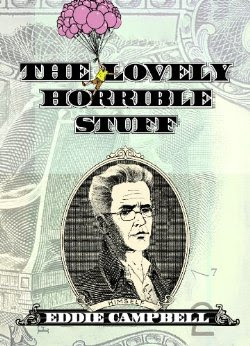


This last one I thought had to be a hoax when I came across it early last year. Charlie Parker (last mentioned by me here) and Dizzy Gillespie playing the Town Hall, New York City on june 22 1945 in a legendary concert that nobody knew was even recorded let alone still exists in any form. These two bebop jazz giants played all their earliest innovations during a couple of years when there was a recording strike by the musicians union, so what we have of it is precious to say the least, and much of it is shoddily recorded, not surprising given the equipment that could have been transportable in those days. Now add to that a 40 minute concert in remarkable condition and completeness, and even historical precedecnce: there's a tightly knit and coolly delivered version of A Night in Tunisia here that predates the individual recordings of both Parker and Gillespie of the following year. The notes explain the circuitous route by which the fragile old acetates came to be very recently discovered: "...it was at one of these shows that I met the "picker". A "picker" is a dealer who is constantly searching for the next rarity, looking to quickly turn his finds into cash. 'I just found an acetate of Charlie Parker. I can play it for you over the phone...' He was reluctant to reveal his sources, but did agree to go back to where he had purchased the acetate to see if there were any others. Two days later I received a fax that he had found another six discs! Each disc ended abruptly without an overlap, and I mistakenly interpreted this space in the music to be equal to the time it took to turn the disc over to record the other side. it was only last year that it was determined that this concert had been recorded on two side-by side disc cutters- one taking over where the other left off (without the usual overlap) and that there were no spaces, and there was nothing missing!"
Elsewhere in the voluminous notes the event of the discovery is compared, as these things always are, to the uncovering of the tomb of some guy named Tutankhamen, apparently in 1922.

Survival is somewhat random, what?.

Labels: