Thursday, 23 August 2007

"Rabbi Heskel Shpilman is a deformed mountain, a giant ruined dessert, a cartoon house with the windows shut and the sink left running."

I 've been carrying Chabon's new novel around on my travels in the hope of reading it a second time, but I'm being overtaken by myself going the other way, so I'll say something now. My copy doesn't have the attractive cover design at left. I wonder; why is that? I mean, what theory is at work that decides Australia, or wherever else, needs the one with the careening 1940s car? It strikes me as misleading. Chabon says he started to get the idea for the book while reading Raymond Chandler (interview), but we shouldn't forget that they belong to quite different eras of writing. Chandler is one of those writers that more people have something to say about than have ever read him. Mickey Spillane on the surface may be seen to be mining the same genre milieu, that of the heroic private detective, but he too, in his early 1950s post-war conservative mindset was a million miles from Chandler, as noted in this insightful piece by Will Cohu in the Uk's daily Telegraph:
His (Spillane's) books were strip-cartoons, written in brutal prose, with an insistent reactionary heartbeat, the thump-thump of the first person singular and the fist as Hammer smashed another face to a bloody pulp. Chandler aimed for the elite; Spillane for the mob. His books were descendants of the "penny dreadfuls" - mass produced, widely distributed and cheap. Their artwork was almost pornographic (I, the Jury showed a picture of Mike Hammer pointing a gun at a semi-clad woman). He flaunted his lack of literary credentials, calling himself a "writer" and taunting the "authors". He developed an anti-aesthetic.
Chabon's detective story has the literary air of Chandler, with the shiny polished lines: "He wasn't a handsome kid. He had a second chin and the hint of a third, without the benefit of a first." but Chabon's milieu is our own feminized world in which the cop's ex-wife is his superior officer, and in which the details of his partner's kids' 'polar bear jammies' are noted. I don't remember the presence of any kids in any of Chandler's novels, though I'm sure I could be mistaken.

But then it is not exactly 'our own' world, though we might say that in our world an author doesn't need to take time out to explain the concept of 'alternative history.' It wasn't exactly unknown in Chandler's years, given some currency by JC Squire's 1931 anthology If it had Happened Otherwise, containing among other 'what ifs', If the Dutch had Kept Nieuw Amsterdam by Hendrik Willem Van Loon, but five or six decades of science fiction broadcast into our living rooms have made it a commonplace. However, as occasionally happens with a book you have no intention of not reading, I sat down to The Yiddish Policemen's Union without having read or heard a single word about its unusual and imaginary setting. For a while I was mystified and kept on my theoretical toes wondering when and where the hell this was taking place, because the author hasn't posted any signs to tell us. He mostly leaves us to figure it out, though by the time things get complicated he had me looking extratextually for a specific answer. Chabon's theoretical Yiddish community is thoroughly worked out in its hierarchies and underworld with its slang, where a gun is a 'sholom' (peace) and a mobile phone is a 'shoyfer' (ritual ram's horn). I love this book. Y'know, I really should just cancel a week of stuff and read it again.
*************

At some point in the draft of the above I was speculating on Chabon's difficulties in following up on his Pulitzer winning Kavalier and Klay when my thoughts turned to another great writer who ran into follow-up trouble, Ralph Ellison. (and I love this title...)
The Invisible Manuscript- Washington Post-Sunday, Aug 19-

Ralph Ellison died leaving four decades'worth of scribbled notes, thousands of typed pages and 80 computer disks filled with work on an ambitious second novel. For 14 years, a pair of literary detectives labored to fit the pieces together. Now they're ready to share with the world.

I almost wrote about Ellison's supposed writer's block in my Fate of the Artist but sensed that I was way out of my depth:
It was only after Ellison's death that Fanny Ellison chose Callahan to become literary executor. This was an honor, but it soon became clear it was also a Herculean task. Manuscript pages, computer disks and scribbled notes lay helter-skelter, everywhere in his home. Ellison had not suffered from writer's block, after all. He had writer's fury. He had written and written and written. A gush of words, and chapters and notes about the chapters. There were background notes -- musings on writing and America and fiction -- much of it also beautifully written; notes about plot outlines and more characters, built word by word, then buried under more notes. It was a spouting gusher of artistic creation, fat manuscripts covering other fat manuscripts, almost all related to that second novel.

(via Bob Morales)

Labels: , , , ,

Sunday, 4 October 2009

Tom Spurgeon contemplates an article from a couple of months back: On The Subject Of Return Reading
"The author and music writer David Gates penned an article this summer for Newsweek -- where I think he's a staffer -- on the pleasures of re-reading. Gates seems to view re-reading as way to spend time in the company of memorable characters that have touched him in his lifelong give-and-take with literature."
..and selects his favourite handful of books for reading again. Coincidentally, today I just finished reading The Amazing Adventures of Kavalier and Clay for the second time. I picked it up to momentarily derail my brain from an irritating subject and then wrote off most of the weekend in its company.

"In the immemorial style of young men under pressure, they decided to lie down for a while and waste time."

"Dinner was a fur muff, a dozen clothespins, and some old dish towels boiled up with carrots. The fact that the meal was served with a bottle of prepared horseradish enabled Sammy to conclude that it was intended to pass for braised short ribs of beef. Many of Ethel's specialties arrived thus encoded by condiments."

"The pyjamas were patterned with red pinstripes and tiny blue escutcheons. Sammy was wearing a pair that had red escutcheons with blue pinstripes. That was Rosa's idea of fostering a sense of connection between father and son. As any two people who have ever dressed in matching pyjamas will attest, it was surprisingly effective."

It's a wonderful book, and I thought Chabon spoiled things a little by allowing Dark Horse to adapt the Escapist, the comic book character invented by the two young men, into an actual comic book series. I wasn't dismayed enough however to turn down the opportunity to do my own version of the character. This was in 2005, and in the same issue as the last thing drawn by the late Will Eisner. Dan Best wrote the story, which was set at the 1940 Empire City World's Fair, an approximation of the famous NY one. The Escapist has to get himself out of the time-capsule. The New York one was just a couple of feet high, but this one was big enough to imprison a person inside along with the other stuff that was being salted away for future rediscovery a thousand years later. Actually, we didn't know the NY one was so small until we had already committed ourselves. I found a load of old pictures of the NY Fair, which fascinated me for their oddly tinted colours, which I presume are a result of the aging of printing inks, or the yellowing of paper, or the imperfections of early colour photographic reproduction processes, or all of the above. I tried to capture the odd harmonies that I saw in the old photos:


It was twelve pager, but Michael suggested a sharper ending (showing the opening of the time capsule a thousand years later and the odd thing that was found there) that required us to add a thirteenth page. I was glad to see him tinkering with the stories, like I'd hoped Eisner would have done with the New Adventures of the Spirit, though I'm sure his Pulitzer prize-winning time would have been better spent working on his next novel.

Related: I just noticed that there's an excellent portrait of Michael Chabon by Tom Yeates currently at the top of Steve Gettis' Hey Oscar Wilde page
Previous posts on Chabon, including the last that was heard of a possible movie adaptation of Kavalier and Clay.

Labels: ,

Friday, 4 May 2007

HAPPY STAR WARS DAY!

MAY THE FOURTH BE WITH YOU!
The epic saga began with the film Star Wars (later retitled Star Wars Episode IV: A New Hope), which was released by 20th Century Fox thirty years ago on May 25, 1977. But we here at campbell blogspot have decided to rewrite history, much like Lucas did and make it May 4.

HAN SHOT FIRST!
Long time readers of me blog will remember me telling the anecdote of how writer Bob Morales used the "Han Shot First' motto as the springboard to a plot twist in which Steve (Captain America) Rogers, while on his way back to his own timestream, makes a detour in which to alter history and put the twin towers back up. I didn't have the art handy then, but I have it now and I've attempted to peel back one of the paste overs to reveal the original motto on the t-shirt, as it looked before our editor decided it was too risky. (though looking at my crap lettering it's undoubtedly a good thing that I got stewart McKenny, then assisting me, to put something more professional over the top of it.)


(Brian Reber was colorist)

Those R2D2 mailboxes... Are they up and running yet?
*********

in other news:
This made me laff:
Gary Groth told to bugger off (or words to that effect) by Shannon Wheeler. (via Heidi, who shows a photo)
Groth vs Ellison. The last time we contemplated one of them here at Campbell blogspot our mind became unhinged and we gibbered incoherently about a gecko invasion from outer space for the rest of the week.
(my official opinion: there is not so much money in this game that idiots should be wasting it on lawsuits.)

Chabon's frozen Chosen
By Sean Rubinsztein-Dunlop. Wednesday, May 2.
"Chabon's novel is laden with mysteries but the chief one is whether groups can claim that things are meant to be.
HarperCollins is probably just wondering whether the book can make a profit.
'The stakes are high,' spokesman Jonathan Burnham admits, 'for Michael and all of us.'"

Labels:

Tuesday, 2 December 2008

this has all the earmarks of a publicity stunt, but here we go anyway:
130,000 inflatable boobs missing at sea
MORE than 130,000 pairs of plastic inflatable breasts have been lost at sea en route to Australia.
Men's magazine Ralph was planning to include the boobs as a free gift with its January issue.
The cargo is worth about $200,000, which is another blow for publisher ACP's parent company PBL, which is already in $4.3 billion of debt.
A spokeswoman for Ralph said the container left docks in Beijing two weeks ago but turned up empty in Sydney this week.
(link thanks to Michael Evans)
*********

Callum was looking at the Italian edition of King Bacchus, wherein you will recall that I illustrated a legendary meeting between Neil Gaiman and Alan Moore (one of many of course), and he has drawn my attention to the fact that they have translated 'Neil scary-trousers Gaiman' as "Neil pantaloni orridi Gaiman." I call upon my Italian correspondent, Nathalie, to opine whether this is a good translation or otherwise (or otherwise we shall all start using it).
Neil explains the origin of the nickname:


(ps the book was King Bacchus , but it is out of print, in English at least.)
**********

THE AMAZING ADVENTURES OF KAVALIER & CLAY May Yet Unfold In Live Action!
Two years ago, it appeared that Stephen Daldry was locked in to direct the long-awaited adaptation of Michael Chabon's Pulitzer Prize-winning novel, THE AMAZING ADVENTURES OF KAVALIER & CLAY. His stars: Tobey Maguire as Sam Clay, Jamie Bell as Josef Kavalier and Natalie Portman as Rosa Saks.
Well, that didn't happen. In an April 2007 interview with DETAILS, Chabon, who also wrote the screenplay, lamented that "...it just completely went south for studio-politics kinds of reasons that I’m not privy to." Bummer.
But no project is ever completely dead in Hollywood...

Labels: ,

Monday, 10 March 2008

Every time the annual San Diego convention comes around (July) I always notice I have a pile of stuff from the previous one that I haven't read yet. I do dip into it from time to time. Today I picked up the promotional excerpt from Austin Grossman's Soon I will be Invincible, consisting of the first two chapters. The book was published last June I believe. I found myself talking to the author (he must have been talking in turn to a mutual acquaintance as I walked past or something). I referred to Grossman once before, on June 15 when he was reviewed in the NY Sun. His writing is casually and stunningly intelligent. Almost every paragraph is bejewelled with wit:

Most of them are naturals, superpowered since puberty or before. Powers that came on their own. Naturals are the world talents that form out of the ever-churning soup of the human megapopulace by accident or fate. Once in a hundred million times, a lifetime of factors align, and at the right moment something new coalesces out of high-tech industrial waste, genetic predisposition, and willpower, with a dash of magic or alien invention. It started happening more often in the early 1950s and no one knows why- nuclear power plants, alien contact, chlorinated water, or too many people dancing the Twist.
(In the indicia is a note that says "THIS IS AN UNCORRECTED PROOF. IT IS NOT FOR SALE AND SHOULD NOT BE QUOTED WITHOUT COMPARISON WITH THE FINISHED BOOK. I hope they caught the typo on page 29, a simple transposition of 'the' and 'in' that would not have been picked up by spellcheck)
The US edition has a gorgeous cover designed by Chip Kidd while the UK ed. has a hideous illustration that makes it look like a comic book. You can see them both at the Wikipedia page for the title. Visualising Grossman's characters in such a literal way, i.e. they are 'comic book characters', so here's what they'd look like on the front of a comic book, undermines much of the author's work toward making something more of them.
Right about now somebody is going to observe that I'm writing about a book after having read only two chapters. I'm giving Grossman the benefit of the doubt and presuming he continues as well as he starts, all through the plot of his story. My point is that the plot would not interest me as a plot in itself. Truth be told, the plot in Chabon's The Yiddish Policemen's Union, my favourite book of last year, became less interesting to me the closer it got to resolution. How else can you wrap up a crime story except by solving the mystery? The book was most interesting to me about 45% of the way through. The sophisticated reader knows that the plot in this kind of book is not the heart of the thing. Sure it is what the book is 'about', but it is as much 'about' the plot at 45% as it is at 99%, no more no less. It gets no further from nor closer to its subject. The cumulative tension is never entirely real, in fact the negation of the possibility of 'real' is our postmodern motor. A latent sense of form, and a publisher's need to sell books, demands that we go through the motions and act out the bogus drama if we lack the courage or imagination to do otherwise.

Looking at the Wiki entry linked above. I notice that there are template subject headings, "Plot", "Characters" "Major Themes", "Literary Significance", "Allusions and references", and that the penulitimate of these has no content. It just says:
Literary significance and reception
This short section requires expansion.
What? Can it be that Grossman was so busy with last minute preparations and looking for that typo on page 29 that he forgot to include the 'Literary significance'? I'm reminded of an old friend of mine, who was a very clever chap with academic accomplishments, but he appeared to think that the composition of a piece of fiction involved thinking about all those things separately, first 'plot', then 'character', 'themes,' etc. and putting the work together in the same order in which scholars conventionally dismantle it.
And for all I know, the rest of the world thinks it is so.

Meanwhile, Children's book art gains mainstream acclaim
-By Stephanie Reitz -Associated Press- 03/07/2008
They're not the "Mona Lisa" or "Whistler's Mother," but images such as the Cat in the Hat, the Very Hungry Caterpillar and other icons of illustrated children's books are gaining respect in highbrow art circles. Once seen as fun but forgettable, the genre is now being featured in mainstream museums and dissected in college art courses.
"It's undervalued as an art form. The great children's book artists are drawing from art history and the trends of their times," said H. Nichols B. Clark, director of the Carle Museum, which features numerous artists and houses pieces from Carle's decades-long career, including his signature Hungry Caterpillar.
"I can't say we're viewing it quite the way we're viewing Monets, but I do think there's been more attention and focus on this," said Jean Sousa, the Art Institute of Chicago's director of interpretive exhibits and family programs. "It's a distinct entity. It doesn't have to compete with the Monets of the world because it has its own special value as art."
The appeal of some images has lasted over the decades, such as H.A. Rey's "Curious George" and Beatrix Potter's "Peter Rabbit."
But art historians and educators say only time will tell which of today's illustrations become tomorrow's icons. From Caillou to Captain Underpants to Lilly's Purple Plastic Purse, the staying power has yet to be seen.
"There are some that are likely to be around forever, but we just can't predict yet which ones they'll be," she said.
The 'art world' is inordinately concerned with what, like the proverbial bad smell, is going to hang around. Time has a cumulative and selective intelligence and posterity will have the vantage of hindsight and therefore be more enlightened than the here and now.
And for all I know, the rest of the world thinks it is so.

Labels: ,

Thursday, 13 March 2008

Some comments from Monday and my reference to Chabon's salute to Raymond Chandler started me thinking about the plotting in crime fiction. I took a few critical reviews last year when I tackled The Black Diamond Detective Agency. Some reviewers at the time thought it too hard to follow to be an enjoyable read. Which is certainly what I intended, or at least the first part of that equation. Any crime mystery that can be easily grasped is not worth the trouble of reading. A good mystery story requires some detective work from the reader, going backwards and forwards to make sense of it, even after you've finished the book. I changed the identity of the villain, and consequently the motive, to try to put some complexity into it. But like the subjects of Monday's post, the 'plot' is a received thing, passed down through a long line of other stories before landing in this one. I figured my piece could at best be 'a story about another story' and gave it my best shot.

I sat through one of the recent productions of Miss Marple with Geraldine McEwan in the title role. Even with the assorted controversial additions and alterations, and with the best will in the world, I can't help but see the whole thing as a tiresome exercise in the antique. I can get less excited about it than can the sad old clock that has appeared every night in The Mousetrap since that play opened in 1952. There's something that ought to disturb us about turning the tragic human mess of a murder into a parlour guessing game, as Alan Moore has said often in reference to his approach to From Hell. He supplanted that with his own insane recreation 'The Dance of the Gull catchers,' in which he debunked all of the theories including his own, and I was pleased to illustrate it. The movie turned it back into, if not a parlour game, a back alley round of pitch and toss.

In the whodunnit the solution is so often a pin that lets the air out of the balloon, dispersing forever anything that was there in the first place. I watched The Black Dahlia on dvd. It has a deceitful narrative logic justifying a catalogue of grotesque improbabilities. The final one is the detective executing the villainess in the motel room. But then this is De Palma we're talking about, who twisted the Untouchables into a tortured shape and God knows what he was thinking about with Scarface. Spillane's Mike Hammer at the end of Kiss me Deadly sets the villainess on fire, but then she was in the middle of killing him. I check wikipedia. sure enough, in Ellroy's Dahlia the detective more logically just arrests her. It's the movies, you see. They have to crank up the action a couple more notches and logic be damned. Neither did Spillane like the movie version of his own Kiss me Deadly, which upped the ante by throwing a radioacive isotope into the plot: Bezzerides wrote of the script: "I wrote it fast because I had contempt for it ... I tell you Spillane didn't like what I did with his book. I ran into him at a restaurant and, boy, he didn't like me"

In the extended series of character driven whodunnits like those tv sleuths Cracker or McCallum, their family and acquiantances are in turn used as plot springboards and victims until the hero sinks in a hopeless swamp of dirty secrets and raw vulnerabilities. I've never affected the necessary degreee of cynicism to stick with these for long. If I have nothing on my mind and I find myself at the tv flicking through the channels, I can maybe sit through the workaday investigations of CSI, though it would never occur to me to make a point of watching it..

I was once fond the great first era of the hardboiled crime writing, with its helter skelter style. The recent Pulp Fiction 'The Crimefighters' anthology which I reviewed here had a fine story by Chandler, the touching ending of which has stayed in my mind for months. After retrieving the necklace that was the subject of the piece, Marlowe has a copy made to give back to his client to save her feelings if she should find out the thing her late husband gave her was in fact bogus. "You were right," she said, "They are not my pearls." And the story ends with him throwing the pearls of the 'original fake' into the sea from a forlorn rock. "They made little splashes and the seagulls rose off the water and swooped at the splashes."
For a minute or two there was a dark and unfathomable poetry in the genre.

Labels:

Monday, 14 May 2007

"What else are we missing?"

Michael Evans sends me this thought for the day:
"Artists are the antennae of the race, but the bullet-headed many will never learn to trust the great artists."- Ezra Pound
*******
I missed this from last month's Washington Post. They had the idea of placing one of America's finest violinists as a busker in the morning rush and gauging the reaction.
Pearls Before Breakfast: Can one of the nation's great musicians cut through the fog of a D.C. rush hour? Let's find out.
By Gene Weingarten. Washington Post Staff Writer. April 8
"In his 2003 book, Timeless Beauty: In the Arts and Everyday Life, British author John Lane writes about the loss of the appreciation for beauty in the modern world. The experiment at L'Enfant Plaza may be symptomatic of that, he said -- not because people didn't have the capacity to understand beauty, but because it was irrelevant to them.
"This is about having the wrong priorities," Lane said.
If we can't take the time out of our lives to stay a moment and listen to one of the best musicians on Earth play some of the best music ever written; if the surge of modern life so overpowers us that we are deaf and blind to something like that -- then what else are we missing?"

(via Bob Morales)
********
I'm reading Chabon's new book, The Yiddish Policemen's Union, and enjoying reading his finely chiseled prose as much as he appears to have enjoyed writing it, though of course it is generally wise for one to avoid the presumption that a writer got any kind of similar pleasure from the writing of a work as one got from reading it.
"And just last week, amid the panic and feathers of a kosher slaughterhouse on Zhilovsky Avenus, a chicken turned on the scochet as he raised his ritual knife and announced, in Aramaic, the imminent advent of Messiah... the miraculous chicken offered a number of startling predictions, though it neglected to mention the soup in which, having once more fallen silent as God Himself, it afterward featured. Even the most casual study of the record, Landsman thinks, would show that strange times to be a Jew have almost always been, as well, strange times to be a chicken."
********
If you've never seen Alan Moore's drawings of Glycon and Asmodeus, John Coulthart shows them here, and you can enlarge them enough to appreciate the detail.
*********
Neil Gaiman has the photos of the wedding of Alan Moore and Melinda Gebbie. I saved that till the end knowing that if you went there first you'd forget to come back here.

Labels:

Friday, 16 February 2007

BIG HEADS & fancy frocks

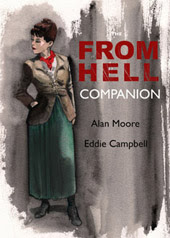
I've been showing a few pages from Chapter 5 of FROM HELL over the last three weeks (jan 25, 29, feb 2, 11, 12). As you've seen, this was a chapter where we thought hard about the differences between the well-off and the downtrodden. I pondered at some length over how different society must have looked then. It's a matter of historical record that Britain's officialdom didn't realize how far the relative health of the classes had drifted apart until they were drafting men in 1914 at the outbreak of World War 1. It was observed with some concern that the enlisted men were of a smaller stature than the officers. This gave rise to a more thorough health system in the years after the war, including free milk at schools etc.
It's interesting how since then, there is always some scientist with his eye on the height chart: "Americans used to stand tall as the people with the highest average height in the world. However, since the middle of this century, several Scandinavian countries have moved ahead and now have taller citizens on average than the United States."
"MEN FROM EARLY MIDDLE AGES WERE NEARLY AS TALL AS MODERN PEOPLE"
The guy in the above link is measuring old bones, but from my point of view as an artist, it's not necessary to go that far. The eyes will do it. As every artist must or ought to know (and there is evidence to suggest they might not) the head to body ratio in a figure will tell you what height the person is supposed to be. (I couldn't tell you how many heads or whatever, that's for people who depend on rulers rather than eyes). The body grows more and at a faster rate than the head, therefore the ratio of body to head will always be increasing during the period of growth until it halts at its final relationship depending on total height. As a kid in the mid sixties I was fascinated with Jack Kirby's concept of the figure; his heroes were big, bold and blocky. But as I came to look at a lot of classical art and even other comic book art, it struck me that Kirby's figures, especially in the early sixties and especially when he was galloping through a job, had their own particular proportions. The figure of Giant Man (above right) in Avengers#4 from 1964 has not been conceived as a gigantic being, but rather as one of small stature simply scaled up. If you take away everything else in the picture, the figure would be read as a fit and well built adult male of around five foot one inch. Kirby probably noticed this tendency in his work, because it submerges as the decade advances. Later I came to know that Jack was a wee fellow himself, and this undoubtedly figured in his concept of ideal proportions. And so it should.
It would be difficult to not show Jackie Estrada's famous photo of Jack Kirby and Alan Moore together at this juncture (and I do so with permission). Even allowing for a natural distortion of perspective, it's the sweetest way to make the point.
I'm not saying I thought about this a great deal while drawing From Hell, but it was certainly a constant in my thinking that the world of Victorian London would look and feel very strange to those, or most of us, living at the far end of the twentieth century. Another question was: just how filthy would it have been? By many contemporary accounts, sickeningly so. "Streets were fog-and smoke-cursed, and the humbler houses noisome... the park was impregnated with a sort of black stuff left by winter smoke, and St. Paul's Cathedral was so besooted that it seemed built of coal". I was quite happy with the first printing of the big From Hell in 1999 because, in addition to all my efforts to contrive an art style that was dirty and sooty, Preney's printing job had increased the effect; you couldn't handle the book much without moving some of that soot around in the margins
Talking about those coloured dresses the other day got me thinking back to my childhood in Glasgow, another big sooty city, even as late as the early 1960s. Everybody dressed in economical nondescript colours unless they were going to a party (or else to bed; pyjamas could be gaudy). But I have to interrogate myself to ascertain whether the absence of colour in my memory is due to the tv and newspapers of the time all being in black and white. Bright dresses are what they wore in films based on Broadway musicals that your auntie would love, like Seven Brides for Seven Brothers. (pictured) I was too busy watching Cagney and Bogart in noir, where everybody, including angels, had dirty faces. Even kids comics were in black and white in Britain. Discovering Marvel in the mid sixties was like opening the skylight of the universe.
I recall a line from Chabon's Kavalier and Clay, but I can't locate it again so this may be inexact. It's about the colorful costumes of the superheroes, created in a period when kids were dressed like small adults: "...created by people not given leave to dress themselves. No doubt about it, this was kids' stuff." The heroes don't dress like that so much now, or at least not in the movies, and kids now dress themselves, and the world is now run by kids, or at least the world now permits adults to remain being kids. It's just that their heads are out of proportion.

* * * *
And speaking of wee men with big heads, an email from Hayley Campbell, who types like archie the cockroach: 'oh by the way, it was revealed yesterday in a tabloid interview with robbie williams' ex-lover that he was 'obsessed with googling himself and wouldn't leave the house until he'd done it'.

Labels: ,

Tuesday, 12 February 2008

Two pieces of movie news from my pal Lee Slattery:

Fox sues over 'Watchmen (The Hollywood reporter- Feb 12, 2008)
20th Century Fox has initiated a legal battle against Warner Bros. over the rights to develop, produce and distribute a film based on the graphic novel "Watchmen." On Friday, the studio sued Warners, claiming it holds the exclusive copyrights and contract rights to "Watchmen."...


Coens speak 'Yiddish' for Columbia (Variety-feb 11))
For their next collaboration, the "No Country for Old Men" team of Joel and Ethan Coen and producer Scott Rudin will transfer another Pulitzer Prize-winning author's work into a film.
Columbia Pictures has acquired screen rights to the bestselling Michael Chabon novel "The Yiddish Policemen's Union," with the Coens writing, directing and producing with Rudin....

Labels:

Monday, 25 June 2007

Kids' stuff.

C omic books in their first great flourishing were a genre of popular fiction in which characters were illustrated wearing gaudy clothes, aimed at a class of people "not given leave to dress themselves. No doubt about it; they were kids' stuff." (last bit's from Chabon's Kavalier and Klay... apologies if I've misremembered it). In their current great flourishing we need scholars to explain them, even though they have not changed much.
Salon.com presents an excerpt from Douglas Wolk's Reading Comics: How Graphic Novels Work and What They Mean. to be published by Da Capo Press on July 2, 2007.
Comics fans, grow up!-June 23.
"With the rise of the graphic novel, comics have hit the big time. It's time for fans to quit whining and celebrate their favorite art... "
Where is he headed? An 'art' has 'fans'? (I'd like to buy an art please, said Dr Zoidberg when he came into some money).

"The blessing and curse of comics as a medium is that there is such a thing as "comics culture." The core audience of comics is really into them: we know that Wednesdays are the day when new issues appear in the stores, we populate endless Web sites and message boards..."
Looks like it will be a thorough history of the comic book genre, which does have 'fans', and I'm writhing in embarrassment at the thought that somebody might think i'm one of them.

"Over the last half century, comics culture has developed as an insular, self-feeding, self-loathing, self-defeating fly-trap. A lot of the people who hit their local comics store every Wednesday think of comics readers as some kind of secret, embattled fellowship..."
'Secret embattled fellowship' expresses it better than my 'loose-knit society of fellow travellers' of june 9. Wolk's phrase, with its hint of more desperation, would have suited my enquiry better, and supported my conception of it as a 'genre allegiance', a modern mindset that we recognize but would need a psychiatrist or sociologist to explain to us. Commentary on the genre has taken a sad turn of late. Paul Gravett's books have been giving me the same disquiteing feeling. In fact, hasn't wee Paul already covered all this, him and everybody else who has made a semantic mud puddle and then cheerfully stepped in it (like my commenter (hi, Steve) of June 15 who wound up arguing about the definition of the word 'definition' and who will probably be back for another serve at the end of this):
"But the "novel" part of "graphic novel" blots out the idea of short fiction and nonfiction -- it's odd to call, say, books of reportage in cartoon form by Joe Sacco ..."Graphic narrative" sounds like a euphemism twice removed from its source, and still has the unfortunate resonance of "graphic" with the way it tends to be paired with "sexuality" or "violence." And "sequential art" sounds utterly arid."

I've always thought that to describe comicbook culture beginning with its 'fan' roots would be the honest thing to do, as opposed to the other approach, in which aspects of ancient art (eg. the Bayeux tapestry) are cunningly and dishonestly 'colonized'. However I would have drawn the line at offering it to the world at large for fear of looking foolish, and not only because of our tedious arguing about the naming of things. The triumph of this geeky subculture in the big world can only presage the downfall of good taste. Oh, what am I blathering about; that got fucked a long time ago.
******

If you're still with me, here's another cover:
My best ever party trick was making issue 50 coincide with the new millenium; I gave Mick Evans the painted figure and the little sketch and he made a lovely design of it even though he still argues to this day that the millenium wasn't until the following year. Here's my four pager about millenium night, from After the Snooter
********

in other news: (the catholic boy in me couldn't less this one go by)
The Vatican issued a document listing its rules of the road, including one warning against using cars "as a means for outshining other people and arousing a feeling of envy."
"Unless having fun has become a sin, I don't believe it (to be wrong)," Amedeo Felisa told Reuters this week at an event celebrating Ferrari's 60th anniversary in its hometown southeast of Milan.

Labels: , ,